
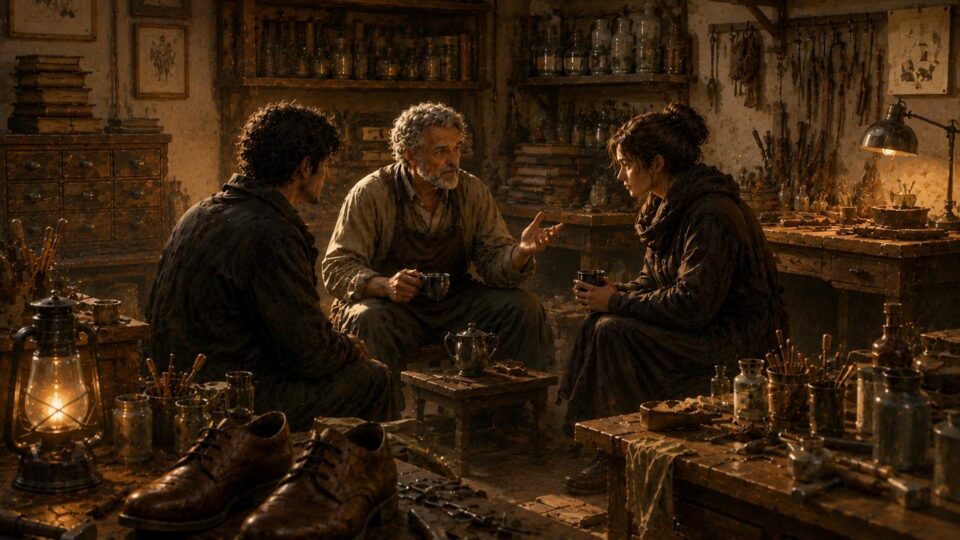
As usual, it was still the early hours of the morning when I entered the small workshop of Loureiro, the shoemaker who loved philosophy books and red wine, in the little town of narrow, winding streets nestled at the foot of the mountain. His unusual business hours made the atelier not only a safe haven until transportation became available at dawn for my journey to the monastery, but also a point of departure for a voyage into places within myself that had previously been unknown. I was welcomed with a warm embrace. Outside, the air was cold and a light drizzle fell. Without delay, the shoemaker brewed a pot of coffee and placed it, along with two mugs, upon the heavy wooden counter. We were ready to continue our endless conversation. Yes, that was the genuine feeling. Although we had met many times and discussed countless subjects, our conversations intertwined like the threads of a single fabric. The fabric of consciousness.
At that very moment, we were surprised by Betina’s arrival. The expression on her face revealed the turmoil in her soul. The young woman, about thirty years old, was the daughter of Renê, the town’s bookseller and Loureiro’s lifelong friend. She had just had yet another argument with Carlo, her husband. Quarrels were both the hallmark and the constant feature of their troubled marriage. Although there had never been any physical violence, the harsh tone of voice and the unkindness of the words exchanged revealed a clear lack of mutual respect. Whenever this happened, Carlo would spend a few days at his mother’s house in a nearby town before returning to the arms of the woman he called the love of his life, swearing eternal love. Betina had believed that marriage would change her husband’s hot-tempered and impulsive nature. A common and ordinary mistake. Intimacy has the power to reveal the ghosts and monsters hidden away in the secret drawers of consciousness, but almost never to educate them. She confessed that she was exhausted by the relationship. Yet she loved Carlo, and she knew he loved her as well. His promises of love, together with his assurances that such outbursts would never happen again, kept her from turning him away. Again, and as many more times as might be necessary. They never gave up on each other. To her, that was undeniable proof of the love that united them.
As elegant as always, Loureiro welcomed her with affection. After a long embrace, he seated her beside me and served her a mug of coffee. Once she had recounted what had happened, Betina asked why love, such a beautiful and noble feeling, could be the cause of so much suffering. Calmly, in his gentle, husky voice, the shoemaker corrected her. “Contrary to popular belief and to what poets sing, love has never been the cause of anyone’s suffering. What causes so much pain is the lack of understanding of what love truly means and how far it reaches. Ignorance about love leads us to confuse it with other feelings of poorer and shallower shades”. He took a sip of coffee and continued. “As an ancient alchemist once taught, to live love, it is not enough simply to love. Love requires learning, just like everything else in life. The mere fact of loving and feeling loved does not free anyone from the traps of feelings that possess little or no nobility, feelings that make us believe they are love while actually representing its opposite. One must understand the nuances, layers, breadth, and depths of love; otherwise, one will never know the liberating and peaceful power offered by this wonderful feeling”.
The young woman asked whether Loureiro was implying that there was no love between her and her husband. The shoemaker shook his head and replied, “I did not say that,” then paused before finishing his thought. “But neither did I say the opposite. It is up to each person to identify the feeling that either expands or narrows their ability to think, to be, and to live. Feelings influence our reasoning, our behaviour, and our choices. They either lead us along roads or send us plunging into abysses”. He took another sip of coffee and added, “When I speak about the importance of understanding a feeling, I mean the need to name it without deception or prejudice. Every feeling has a name. Calling it by its proper name is essential if we are to understand the best way to use it in favour of our own growth. Some feelings, because they are good and subtle, call for constant encouragement so they may blossom, while others, because they are dense and harmful, require transformation. Both contain important evolutionary aspects. But if you fail to recognize them by their true names, you will continue to mistake one for another. Misusing the elixir gives rise to poison. That is the true origin of the pain people mistakenly attribute to imaginary forms of love”.
He drank another sip of coffee and concluded, “No feeling, however undesirable, should ever be treated as an enemy. In truth, they are precious messengers, for they reveal a heart that has not yet been understood and longs for transformation. A heart misunderstood by itself, because each of us is responsible for our own feelings. Blaming the world for the discomfort we experience reveals nothing but immaturity”.
The young woman asked how she should deal with bitter feelings. Loureiro explained, “Do not drive them away, for no one possesses such power. Feelings echo the essence of who we are. That echo reveals the existence of an intimate and genuine voice arising from the depths of the heart. One may hide or disguise feelings for a while, but there is no way to remove oneself from oneself”. He set his mug upon the counter and went on. “Denying bitter feelings is even worse. It is the same as authorizing a chaotic force to act without any supervision. Your choices and behaviour will be constrained and manipulated. No one can protect themselves from what they believe does not exist. Nothing is more harmful than persisting in this corrosive habit. The task is to accept and identify the bitter feeling as a sincere and reliable path toward self-discovery. Then welcome it and educate it, as a good father would do with an immature and rebellious child, so as to bring about a healthy and effective transition from the soul’s childhood to the maturity of life. Every shadow carries within it unmistakable seeds of light”.
Betina asked the shoemaker to explain further. Loureiro summarized, “If there is pain, it is not love”. The young woman argued that, by obvious conclusion, according to that theory she did not love her husband. Once again, the shoemaker corrected her. “I did not say that. I say that love is never the root of suffering. Perhaps there is love between you; perhaps there is not. But discover which feeling is making you suffer and, more importantly, whether that unknown feeling is the reason the two of you remain together”.
Betina looked stunned. She had never seriously considered such a possibility. She wanted to know what the alternatives might be. The shoemaker listed the principal ones. “Emotional dependency reveals the belief that one is incapable of managing one’s own life, of being happy, or of accepting full responsibility for oneself. Such people believe the other has the power to keep a heart from shattering into a thousand pieces, when in truth that heart has always been broken. Since they do not consider themselves capable, or refuse to accept responsibility and make the effort required to rebuild themselves, they give up governing their own lives in order to live beneath someone else’s emotional umbrella. It is a sad form of self-abandonment. Rather than admit their terror of confronting their own fragilities, they claim they remain with their husband or wife because they love them too much. It is a futile attempt to deceive the mirror of truth”.
He furrowed his brow, and his voice grew more serious. “Financial dependency speaks of the fear of facing life’s adversities, of refusing to go beyond who we currently are and where we stand within ourselves, of becoming responsible for our own survival, or, even worse, of refusing to give up the luxuries and material pleasures provided by someone else. It reveals an attachment to disabling ideas and a taste for comfort, an absurd choice in favour of stagnation instead of movement. Refusing the adventure of life, with all its inherent challenges for growth, reveals a shortsighted perspective and a life devoid of virtue. Regardless of the type or degree of dependency, every form of it reveals the acceptance of fear as one’s jailer. It is the conscious choice of a gilded cage over the freedom of every colour. Each person lives where they decide to remain or where they choose to go within themselves. There is no room for complaint”.
He tapped the wooden counter with his index finger to emphasize his next words. “Although there are many deceptive feelings that masquerade as love, some of the most common are pride and vanity. Quite often, we desperately want to remain beside people we cannot control or who do not desire us. In the first case, the purpose itself has been distorted. Instead of admiring someone for their authenticity and independent will, there are those who launch into a delusional battle to subjugate that person to their whims, driven by the unconscious and primitive desire to control another’s desires and thereby destroy their autonomy. They want the other person to mold themselves according to their own preferences and whims. They behave as though they were in an arena. They feel victorious when they crush the resistance of independence, authenticity, and identity in their supposed enemy, as though a loving relationship were not a beautiful meeting of mutual learning but a war in which there must be a winner and a loser. Pride blinds them to the fact that the only conquest of real worth is overcoming one’s own bad inclinations and illuminating one’s own shadows. Delighting in being master of oneself without wishing to own anyone else is one of the essential foundations of love”.
He made a gesture with his hand, as though stating something obvious. “From there, it is not difficult to conclude that jealousy is pride’s favourite child. Jealousy is born from the fear of being replaced in the heart of the one we want beside us. It is a feeling of possession and domination, the opposite of freedom. From this feeling arises controlling behaviour disguised by false educational arguments. No one changes in order to fit someone else’s preferences. Nor should anyone commit such madness. We change only when we understand that something within us is harmful and therefore requires transformation. It will never happen for any other reason. Suffering arises from stubbornly remaining beside someone who has no genuine affection for us or whose way of seeing the world and living life is fundamentally different from our own. At the harbour of life there is always a small sailboat waiting for those willing to set sail. When that moment comes, simply leave without carrying resentment aboard. Such a departure is a noble act of respect and self-esteem”.
He took another sip of coffee before commenting on yet another common mistake. “In much the same way, relegating love to a secondary place, some people devote themselves to the senseless struggle of living beside someone they deeply admire, whether because of physical beauty or social prestige. By doing so, they imagine themselves greater than they truly are, under the illusion that sharing life with someone desired by many somehow makes them special. They see themselves as the chosen ones. The one whispering such madness into their ears is vanity itself. Suffering will be inevitable, and love has nothing whatsoever to do with it”.
Betina held the mug with both hands. Her eyes closed, she drank the coffee, absorbed in thought. Wanting to leave her alone with her reflections, Loureiro led me to the front of the workshop under the pretence of showing me a new backpack model he had crafted. Made of soft leather, with a variety of compartments for storing everything needed in everyday life, it resembled a work of art adapted for practical use. With an innovative design, it combined exceptional beauty with remarkable functionality. I remarked that there was a section devoted to such objects at the Museum of Modern Art, the MoMA, in New York. Since I use a backpack for work, I wanted it for myself. We struck a good deal. Just then, the young woman called us back. She wanted to speak with Loureiro a little longer.
Betina confessed that her home had become like a battlefield. Complaints had taken the place of dialogue. It had become a place of growing misunderstandings and increasingly rare moments of connection. Only now did she realize it. There was more concern with pointing out flaws than with proposing solutions. Carlo was not the way she wanted him to be, nor did the young woman behave as her husband wished. Yet neither of them gave up trying to mold the other according to their own desires. They no longer cared about the uniqueness and authenticity of the person walking beside them. They thought only of their own immediate interests and preferences. There was no shared construction, the hallmark of healthy relationships, but rather an uninterrupted process of mutual destruction. A never-ending war, the young woman admitted. “And with no winners,” the shoemaker remarked. “That is why we argue, separate, and reconcile, like harmful, symbiotic hosts to one another, trapped in a vicious cycle from which we cannot free ourselves,” Betina concluded.
The young woman asked Loureiro whether, in such circumstances, love could still exist in her marriage. The shoemaker shrugged and answered honestly, “I don’t know. At the moment, pride certainly appears to be the bond holding the relationship together. If love exists, it lies buried beneath the rubble of time and recklessness. It will have to be rescued as soon as possible”.
She wanted to know how she would recognize the presence of love. Loureiro fell silent for a few moments, as though retrieving something precious and delicate from his most intimate memories. When he finally spoke, he did so with his eyes closed, as though he needed to stand before his own heart. “Love wants what is best for the other person, yet refuses to decide in their place. It is gentle and steadfast at the same time. It never tires of helping, yet never conceals mistakes or stubbornness. It is patient, forgiving, and generous in sharing. It possesses an endless supply of embraces, smiles, and affection. It converses without arguing and guides without imposing. It helps without imprisoning. It is happy simply to feel longing. It knows that being together does not require anyone to become the same as anyone else, but that it is essential to rejoice in each other’s uniqueness and to learn from each other’s differences. It helps build the other while continuing to build itself. It is satisfied with the abundance found in little. It understands what was left unsaid. It knows how to hear the no hidden within a yes and the yes hidden within a no. It understands what words remain silent about but actions reveal. It is found in the light shining from the eyes of the one it loves. It walks side by side through the dangers of dark nights and invites us to dance in the joy of every morning”. His eyes filled with tears as he concluded, “Love is all of that, and much more”.
Betina emptied her mug and placed it on the counter. Then she said she would invite Carlo to have an honest conversation. She now understood the feeling that had been holding their marriage together. It was not love. That was why they were both unhappy. What remained to be discovered was whether love was truly there. Not every relationship begins with love as its binding force. Yet some, through the conduct and understanding of those involved, allow love to take root. Good and sincere actions prepare the proper soil for this wonderful feeling to blossom. Many relationships insist on sustaining themselves through burdensome bonds, which is why they prove unsustainable when viewed through the lens of virtue and truth. She needed to understand where she truly stood within herself. There remained the possibility of rescuing the love buried beneath the rubble, if it indeed existed, or of setting out in search of the self-love she had forgotten and, consequently, of the love she had never truly known. In either case, it would be an act of rescuing herself. Every process of healing the soul not only brings suffering to an end, but also grants passage aboard the train of freedom bound for the city of peace. Whether sweet or bitter, every feeling is a place that exists within us. It is up to each person to choose where they will live.
By then, the morning light was already beginning to appear. The young woman thanked Loureiro for the conversation, kissed him on the cheek, and left. The woman who walked out was very different from the one who had entered the workshop before dawn. Her expression had changed. There was a glimmer of hope in her eyes. Her feet no longer dragged across the ground but touched it lightly. I remarked upon this to Loureiro. The shoemaker explained, “The effectiveness of solutions begins with understanding the universe within, so that it may resonate in the world outside. The end of suffering requires this journey of inner discoveries and victories. Everything else is merely disguise, deception, or postponement”.
I asked what would become of Betina’s marriage. Loureiro shrugged once again and replied, “I haven’t the slightest idea”. Then he added, “Whether she leaves or stays, as long as she makes peace with her own feelings, she will begin a serious romance with happiness”. I had to leave, otherwise I would miss my ride to the monastery. I promised to return. The shoemaker smiled as though to say he would be waiting for me. There was still much fabric awaiting the weaving.
Translated by: Cazmilian Zórdic
