
Madureira is one of the most iconic neighbourhoods in Rio de Janeiro. Home to resilient and hardworking people, it has its own characteristics, cultures, and traditions. And a few enchanted corners. In one of them, located on a quiet, tree-lined street that crosses the train station, lives Aunt Francisca, the faith healer. A thin Black woman; simple, humble, and loving; endowed with unusual wisdom and refined speech. Of indeterminate age , I have known her since childhood, when my father, anxious and desperate, would lead me by the hand in search of improbable solutions for a scatterbrained and disruptive boy , she welcomes everyone who seeks relief from the misunderstandings that cause so much suffering. Her prayers serve, among other wonders, to undo quebrantos, a popular term used to refer to the dense energy that surrounds and harms a person when they are mentally or emotionally vulnerable and unsuspecting, trapped in a conflict-ridden relationship steeped in ill feelings. Hatred, as well as sadness , which is, in truth, a kind of hatred disguised as abandonment , may be among the typical effects of a quebranto. The healer warns everyone who comes to her: “Driving away slow and corrosive energies does not free us from them forever. Constant and effective inner work toward self-improvement is necessary. Good thoughts and good feelings are essential in building the work of oneself. No one attracts what they desire; we attract in exact measure to our affinities. We are akin to what we are”.
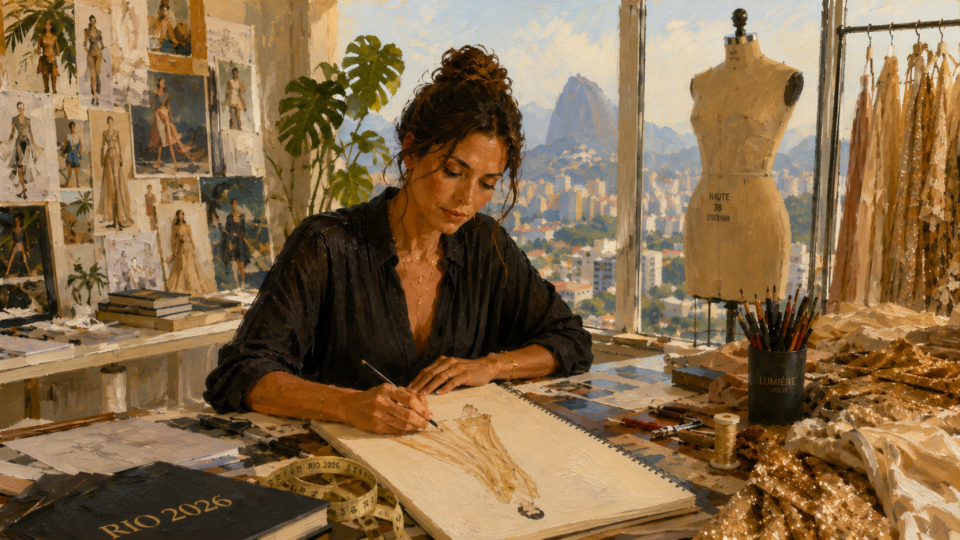
Maura had learned to sew from her grandmother. After finishing high school, she went to work at the atelier of a famous fashion designer devoted to haute couture, whose custom-made and exclusive garments catered to a select group of women who could afford to pay dearly for pieces of fabric cut and assembled with mastery. Besides being an excellent seamstress, the young woman possessed innate talent. She had a gift for designing patterns and creating models of rare beauty. Joana, the designer and owner of the brand, recognized her employee’s gift and encouraged her to study patternmaking and enroll in a Fashion degree. By adding technique to talent, Maura expanded her abilities beyond imagined boundaries. Although the creations continued to bear the owner’s signature, the employee became the brand’s principal designer. In dealing with clients, learning their tastes, intentions, and preferences, Joana remained at the forefront, introducing the young woman as her assistant. Although the owner tried to conceal it, the dresses increasingly bore the unmistakable personal touch of her employee.
Their partnership proved prosperous for nearly a decade, until Maura, encouraged by her husband Hugo, a promising lawyer, decided to forge her own path and established her own brand. The separation occurred without apparent trauma. Joana appeared understanding about her former employee’s choice and regarded the end of their professional relationship as something natural and inevitable. She wished her luck and success, as she said on the day of their farewell.
Maura rented a house in Jardim Botânico, one of the city’s upscale neighbourhoods. With little money, but abundant dedication and creativity, she transformed it beautifully. The space became bright and airy, ideal for welcoming clients into the spacious ground-floor room. The workshop would operate upstairs.
Even before the renovations were complete, two seamstresses who had worked for Joana for many years sought her out. They wanted to change jobs. They appreciated the lighthearted and youthful way Maura treated everyone, making no distinctions based on social class, ethnicity, or any other condition inherent to a person or chosen by right. Maura explained that, for ethical reasons, she could not hire them without first speaking to Joana. She did so, and her former employer raised no objections. Gradually she assembled and expanded her team as the business grew. Some of Joana’s clients began frequenting Maura’s atelier, dissatisfied with the new designs, which no longer carried the traces of the young designer’s style. It was not difficult for them to deduce who had been responsible for the graceful lines of their dresses over the previous years. Maura’s reputation spread beyond the walls of parties and into the intimacy of afternoon teas. Her brand grew to the point of rivaling that of her former employer. Every penny earned was reinvested into the business. Just when the dream seemed tangible and real, everything began to collapse. Many orders were canceled without explanation. Clients vanished as though fleeing a contagious disease. They no longer answered phone calls or replied to messages. Bewildered by the succession of events devoid of reason or explanation, Maura drifted from despair into depression. She could no longer pay salaries or rent. She was drowning in debt. If nothing changed quickly, she would have to close the atelier. She felt defeated. Worse still, she could not identify where she had failed or what mistake she had made.
One of the seamstresses, empathizing with the designer’s suffering, proposed taking her to Aunt Francisca’s house. Maura thought to herself, without saying anything, that a prayer, even if it helped in no way, would do no harm. They arranged to visit her the following morning. However, on the previous evening, when Hugo returned from work, he brought shocking news. A malicious campaign of defamation was underway. During a hearing he had attended that afternoon at the courthouse, he encountered one of Maura’s clients, who was also a lawyer. In a venomous remark, the woman spoke of money supposedly embezzled from the atelier of the former employer and used to finance the opening of the young designer’s business. As if that were not enough, she advised Hugo to open his eyes, for his wife was allegedly having an affair with the husband of her former employer. The proof, she hissed, was that Joana had recently divorced. Maura, she claimed, had been the cause of the marital breakdown.
That day, I had arrived early at Aunt Francisca’s house. I had gone for no particular reason. I had simply felt a strong and sudden urge to visit her. When I entered, she seemed to be waiting for me, seated in her worn blue armchair, “the colour of Our Lady’s mantle,” as she liked to say. She greeted me with a warm smile and confirmed my impression: “I was expecting you,” she remarked, treating the extraordinary as though it were commonplace. Astonished, I did not understand. Aunt Francisca smiled again, pointed toward the simple altar adorned with images of Master Jesus, Mother Mary, and Saint George, which stood in the nearly unfurnished room, save for a few white wooden stools upon which visitors sat to speak with the healer, and instructed me: “Sit on one of the stools, close your eyes, and remain in prayer”. Understanding even less, I was about to ask for an explanation when she calmed my heart: “Soon you will understand”. That was how I became an intruder in Maura’s misfortune.
“It is all lies,” the young designer declared during the only moment she managed to speak without crying. I had no doubt about her sincerity. Aunt Francisca’s gaze confirmed that truth. Yet the former employer narrated her story so skilfully and with such abundant detail that it was difficult not to believe the cruel and absurd version of events that had never happened. Some people possess such extraordinary power to manipulate lies that we sometimes feel no one will ever believe the truth. Maura had spent weeks frightened, desperate, and sad, but now she felt anger. Great anger. The atelier was on the verge of closing. She would lose everything. What she had built with immense effort had collapsed from one moment to the next, without warning or reason. She was determined to take revenge. Through clenched teeth, she vowed to be merciless. Immediately, the healer corrected her: “If you do that, only then will you truly lose everything. The one who will take it from you is your own revenge”. Then she added: “Whoever possesses themselves has lost nothing”.
Dissatisfied, Maura asked in an ironic tone whether she should offer the other cheek. Unshaken, Aunt Francisca nodded and confirmed: “That is the right thing to do”. The young woman declared that she would not allow herself to become a punching bag. The healer corrected her: “I did not say that”. Furrowing her brow, she said firmly: “To offer the other cheek is to present light to those who know only darkness”. She paused before concluding: “Whoever repays evil with evil hands over their own heart as currency. The best revenge is forgiveness. One must free oneself from hatred in order to be happy again. Being happy is the best revenge. No one achieves this without first forgiving”.
Maura argued that the clients would not even listen to what she had to say. There was urgency. Bills were piling up, and the dream was on the verge of turning sour. She needed to cry out to the world. She had a truth to tell and needed to make herself heard. Aunt Francisca explained: “There is no need to tell the truth to everyone. Repeating the truth to all is an invented necessity. Live the truth in every gesture, step, and gaze. Actions will always reach farther than words. Truth is not discourse, but attitude. It is a pillar of conscience and lives in those who breathe in peace. Become the truth through the way you live. Make truth a silent characteristic of your identity. Truth has no need for commotion. Fear and hatred are loud, cowardly, aggressive, and anxious. Truth is courageous, calm, quiet, and knows how to wait. Lies require complicated plots. For truth, a simple yes or no is enough”. As though stating the obvious, she shrugged, smiled, and concluded: “Truth is like that because it knows it is truth”.
The designer confessed that bankruptcy loomed near. If the clients did not return to the atelier, it would be impossible to avoid ruin. She could find no other solution than seeking them out… “To convince them to change their minds,” the healer interrupted, completing Maura’s reasoning as though exposing an inconsistency. Without understanding, the designer widened her eyes as if asking, what else can I do?
Aunt Francisca took the young woman’s hands affectionately and reminded her: “Only fools waste their lives based on someone else’s opinion”. Then she reflected: “Life is full of pivotal moments and, therefore, transformative ones. These are delicate situations because of the risks involved. On one side, we can allow others to decide whether we will stay or leave; whether we deserve our share of their gifts, favours, and beliefs or not. On the other, we can build who we are and where we want to go. Any existential movement, when it concerns a right, requires no one’s permission. These crossroads define the degree of maturity, moral integrity, and personal courage. They determine who will be the author of their own story and who will settle for being a mere character in someone else’s plot”.
Maura swallowed the arguments she intended to use in rebuttal. They were too shallow in the face of the responsibility that, at that moment, awakened within her. She admitted that if she accepted dependence on two dozen clients to define her life, she would be surrendering control of her destiny to others. She would be guided by a will other than her own. She did not want to live that way. She said she did not deserve it. No one deserved it, she added. The healer reminded her: “Each person is where they place themselves, or where they allow themselves to be placed. You may be mistress of yourself, or live like a train traveling on random tracks”. The young woman asked how she could build an authentic path within the existing situation. It was then that Aunt Francisca called on me to see whether I could help in some way.
Although I made every effort to remain in prayer before the altar, I had heard the conversation. I could not avoid it. The healer knew this. She had not seated me there to pray. Maura could not depend on her clients reconsidering their opinions to define her life. That would make her a prisoner of the world’s whims. She needed to forge a new path based on her talent and effort, without being at the mercy of anyone’s moods or malice. She had experience in patternmaking, design, and sewing. She simply needed to chart a different professional course, one in which the target would shift from a specific and restricted center to the margins, always broad, sometimes forgotten, sometimes despised. It is always possible. A solution occurred to me: betting on prêt-à-porter. The term means ready-to-wear. These are high-quality clothes designed by creative designers and manufactured on an industrial scale with the purpose of making elegant clothing accessible, in contrast to the exclusivity of expensive made-to-measure haute couture garments. The proposal is to dress well, with elegance and originality, at low cost. By offering access to many, she would no longer be trapped in the hands of a few.
For an instant, Maura’s eyes sparkled at the idea, only to dim in the next second. The rent for the house in Jardim Botânico was expensive. At that moment, she had no way of bearing the cost. Furthermore, because it was located in a residential neighbourhood, it was forbidden to set up a factory there, even a small one. In truth, she had no means of paying rent anywhere at that time. Aunt Francisca’s eyes sought mine. There was an unspoken request in the light of that gaze. It was neither difficult to understand nor to answer. I owned an empty warehouse a few blocks away, where the printing division of the advertising agency in which I had been a partner for many years had once operated. When the partnership dissolved, the property had come into my possession. For a long time, I had unsuccessfully tried to rent or sell the warehouse. Since then, it had brought me nothing but taxes and maintenance costs. I smiled at the healer and proposed to the young designer that we sign a five-year lease agreement. There would be a grace period with no rent due during the first twenty-four months. After that, she would pay me the market rate. It would be good for both of us. Maura thanked me for the offer. Indeed, it was excellent, but she argued that she lacked the funds to set up the factory, hire employees, and purchase the machines.
If Maura sewed clothes, Aunt Francisca sewed lives. The healer smiled slyly at me. I shook my head no, and she replied with a yes in her eyes. I drew a deep breath, like someone who cannot believe he is about to take the next step, and, in the measured voice of one who reasons while understanding what he says, I proposed a partnership to Maura. She would contribute the design and sewing expertise, while I would invest in purchasing the machines and setting up the factory. I would also use my experience as an advertising executive to create a prêt-à-porter brand. Few times in my life have I seen a smile as beautiful as the one that lit up the young woman’s face. She was back in the game. In an unimaginable way, I too was returning to creation, an old passion. That was when I understood the reason I had gone to Madureira that day. Dreams do not grow old.
We exchanged phone numbers so that we could speak over the next few days. We had much to discuss. Maura asked Aunt Francisca to bless her. The elderly woman explained that the prayer had already been made and answered: “The best revenge is to live well. When you understood that, the quebranto was undone. Your smile is proof of victory over the impositions of the world, possible only because you overcame the bad inclinations that were consuming you”. The designer felt well and renewed. She wanted to pay for the prayer. Aunt Francisca smiled and concluded the consultation: “Go to the altar and thank Our Lord Jesus Christ. To Him belong all honour and glory. To me, nothing is owed”. Then she asked for the next person in line to come in.
Translated by: Cazmilian Zórdic
