
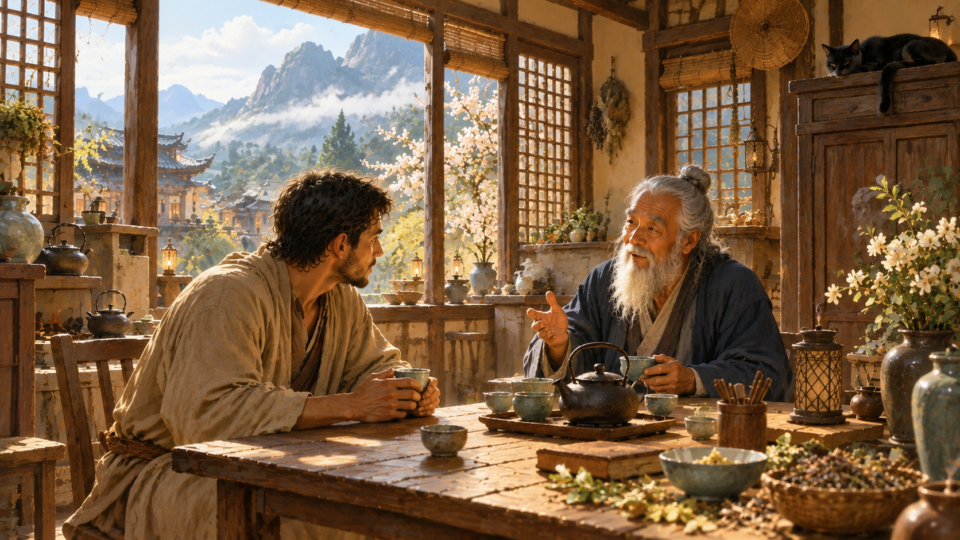
The bus dropped me off in the square opposite the inn in the small Chinese village on the way up to the Himalayas. The innkeeper handed me the room key with her customary bad temper. I left my backpack in the room and, after taking a shower, headed to the home of Li Tzu, the Taoist master. As usual, the gate was open. I crossed the beautiful bonsai garden, fragrant with jasmine incense. When I entered the kitchen, Midnight, the black cat who also lived in the house, gave me a bored look from atop the refrigerator, turned his head away, and went back to sleep. The Taoist master welcomed me with a warm embrace. It had been a long time since I had last visited. As he placed a handful of herbs in hot water to brew some tea, he asked for news of the Elder, as we affectionately called the monastery’s eldest monk. When they were young men, they had attended the same university in England. Despite time and distance, their friendship had remained unchanged. Such is the nature of pure feelings.
He served the tea and sat down at the table. After our initial conversations to catch up on recent events, Li Tzu asked whether my visit was motivated by longing or whether there was another reason. I replied that I was there for both reasons. A beautiful friendship had also blossomed between us, not to mention how much I had learned from the Taoist master. Thanks to the profound layers of interpretation he had guided me through, the Tao Te Ching had become a guide to life as important to me as the Sermon on the Mount had always been. The countless lessons offered by these sacred texts are of inestimable value. Without delay, I addressed the other reason that had brought me there. Over the past few weeks, as though a thick curtain had been drawn back upon waking one ordinary morning, I had become aware of something that had accompanied me throughout my entire existence.
Li Tzu’s attentive gaze encouraged me to continue. I told him that I had realized I had always been very lonely, ever since childhood, even when surrounded by my family. It was not a matter of physical abuse or material neglect, but of disregard and indifference. No one had ever cared about my emotional needs. This was no cheap melodrama. These were facts. There had been decades of interactions and relationships accompanied by countless frustrations and disappointments. Although we saw one another frequently, there was a veiled emotional abandonment. Everyone noticed it, but no one addressed the subject; whenever I tried to talk about it, they changed the subject. I tried to convince them to change their behaviour, to no avail; I tried to understand the reasons behind their attitudes, but could not. As time passed, the emotional abandonment intensified. Little by little, I stopped being invited to parties, gatherings, and Christmas celebrations. Because it had happened slowly and progressively, I had not realized how painful it was. Becoming accustomed to pain is a mistake. We must not believe that suffering is natural, inevitable, and endless. We suffer because of misunderstanding and incompleteness. We suffer because we avoid or deny the truth. Little by little, I had grown accustomed to rejection. Becoming accustomed to suffering does not prevent it from tearing us apart, like a deceitful guest always ready to attack in the dark corridors of wounded emotions. Until I understood that I no longer wanted it living inside me. We all possess this power. Every wound of the soul can be healed. Without exception. Provided, of course, that we manage to illuminate the dark recesses through which dense feelings circulate. Where there is light, darkness withers away. It becomes a territory of peace.
I had no doubt that those situations had been decisive in shaping the person I had become. Yet I needed to understand which good aspects, and which bad ones, had been moulded within me as a result of those existential experiences. This movement is fundamental to the healing process. It takes sincerity and courage first to identify, and then to care for, sufferings so old that we consider them inseparable parts of who we are. They are not. No pain has the right to live forever inside anyone.
Li Tzu looked at me affectionately and reflected, “To begin with, there is an important aspect that deserves emphasis. Despite the many painful situations caused by those from whom you expected love and acceptance because of your blood ties, the suffering they inflicted was never able to turn you into a bitter, grumpy, hopeless, or sorrowful man. On the contrary, despite the pain, I always see you cheerful, good-humoured, and enthusiastic, without lamenting, complaining, or giving up on discovering all the good and beautiful sides of life. And there are undoubtedly many of them”. He took a sip of tea and continued, “These experiences forged aspects of great maturity within your personality. They taught you to become responsible for yourself; to accept the harmful consequences of poor choices; to rely on yourself to solve problems and overcome difficulties; to delight in the silence and stillness of living alone, without, however, giving up the company of other people, even outside the family environment. This taught you that there is a cosmic family even more welcoming than the one formed by blood ties. The bonds of love are infinitely more powerful. Solidarity can be found in the most unlikely places and manifests itself through improbable angels, disguised as utterly ordinary and unexpected characters”. He gently placed his cup on its saucer and remarked, “All these achievements are rightfully yours. A wealth beyond the reach of thieves, moths, and rust”.
He poured me some more tea and added, “Yet I notice that you refer to situations of rejection as though they were emotional fractures. Yes, sometimes that is precisely the effect they cause. The way you deal with the ruptures of the past has turned them into sources of the pain that insists on accompanying you”. I argued that I considered myself a survivor. Anyone who does not drown in the storms of dark feelings acquires tremendous strength, for they learn that they are capable of dealing with any other problem or difficulty. Li Tzu agreed, but replied, “Without question. Nevertheless, a more careful examination is necessary to understand how you have processed the painful experiences of the past”.
Then the Taoist master asked, “Do you know the difference between a survivor and a castaway?”. I replied that the latter, although alive, has not yet been rescued, remaining adrift and at the mercy of the tides. The former, on the other hand, has overcome the storms and stands on solid ground. In short, from an emotional perspective, a survivor is capable of mastering their feelings and is no longer at their mercy. The Taoist master approved of the definition and countered, “Apply this concept to yourself with sincerity and, without denying the truth, tell me whether you are truly a survivor yet”. I remained silent for a few moments to embrace the truth. After a brief and sincere reflection, I had to admit that I resembled a castaway. Some of my emotions still carried me to dark and unfamiliar places. If I wanted to heal, I would have to know myself better, for otherwise I would be unable to take control of those emotions and, through carelessness on a stormy night, I would still run the risk of drowning in them. I could no longer hide behind the illusion of comforting words.
Li Tzu continued, “Emotional shipwrecks can be interpreted as a curse, giving rise to endless lamentations and feeding growing feelings of misfortune and sadness. On the other hand, whatever the tragedy, one can look upon it as a blessing, an extraordinary opportunity to build an excellent character, to discover the master hidden behind difficulties, offering distinctive and unique lessons. Yes, that is what adversity, disappointment, frustration, and betrayal are for. In short, fractures can signify impossibility and bitterness, but they can also lead to the most incredible victories over oneself. Yet true victories leave scars. Not all scars, however, are alike. What distinguishes them is the way they are perceived. A castaway and a survivor do not see them in the same way”.
Those words left me confused. I asked him to explain further. Li Tzu stood up, opened a cupboard, and took out a bowl that had been repaired in several places. There was something different about the repairs on that piece of pottery. They had been restored with a shimmering golden adhesive that, unlike ordinary repairs, emphasized the cracks rather than concealing them. He placed it on the kitchen table. Then he asked, “Have you ever heard of kintsugi?”. I shook my head. He explained, “It is an art of restoration originating in feudal Japan, a time of intense conflicts between clans ruled by the renowned shoguns. Conflicts cause fractures. Emotional ruptures are inherent in life’s educational process and, when properly understood and used, become extremely valuable. Nothing and no one inflicts more devastating defeats upon us than our own emotions when they are still wild and uncontrolled. Every victory in the battle against misunderstood emotions produces a scar. A person’s worth lies in the number of scars they bear. Hence the importance of highlighting falls and fractures rather than hiding them, as people mistakenly tend to do. Based on this idea, the artisans of that era created an adhesive made from lacquer, a natural resin, which they mixed with gold powder to accentuate the broken pieces of porcelain. Thus, the greater the number of repairs, the more valuable the pottery becomes in this Eastern tradition”.
He took another sip of tea and argued, “Hurried and immature observers wonder whether it would not be easier to replace the broken porcelain with an intact piece”. He shrugged and explained his reasoning, “A piece of pottery can be replaced by another; a life never can. This is a symbol of profound philosophical value, one that emphasizes scars as the defining feature of our personal narratives. Every fall, a fracture; every restoration, an achievement. Wherever there is a scar, there was once a blow or a wound. Using pieces of porcelain as metaphors for the heart, they show that fractures and falls do not signify defeat. On the contrary, once restored, they signify the most incredible existential victories. Those who hide them have not yet understood their true value. Falls deserve to be highlighted, without ever becoming a source of shame or humiliation, when followed by the necessary repair and reconstruction. Thus scars are born as symbols of beauty and wealth. They are lines engraved upon the soul by the hands of courage and love. Hence the use of gold to represent this still little-known existential treasure. In essence, kintsugi is not about the refinement of using gold and lacquer to restore broken pottery, but about the beauty of using love and courage to regenerate shattered lives. Where there are scars, there are rich and meaningful stories”.
Li Tzu took another sip of tea and argued, “As long as you observe and treat your fractures as moments of shame, injustice, or abandonment, you will live like a castaway at the reckless mercy of senseless tides. In truth, the pieces have not yet been glued back together, or the repairs remain hidden in the unconscious because you cannot see them as genuine victories. The true value of reconstruction has not yet been understood. You still interpret your troubled family relationships as a personal failure. Thus, suffering continues to make its home in your heart. When you come to see those experiences as definitive achievements, you will no longer allow the frustrations and betrayals of the past to keep stealing the honey of life from you. You will be able to look back on what happened without any bitterness or resentment. The process of forgiveness will have been fully completed. Then, at last, you will have succeeded in crossing the ocean of turbulent emotions and will stand on solid ground, carrying within you all the power embodied in a survivor”.
I interrupted to argue that I had forgiven them. There was no anger or resentment over the fact that they did not like me or had not treated me well. My words were sincere. Li Tzu corrected me: “The issue is something else. As long as you look at your scars and interpret them as a personal failure because you were unable to overcome the rejection or change your relatives’ behaviour, constantly wondering whether you could have done better or should have persisted in the abusive relationship, it means you have not yet accepted the boundaries indispensable to self-respect. You are still in the dark and unpleasant place where your relatives put you, even though you did not deserve to be there. This makes the indispensable and liberating act of forgiving yourself impossible. You punish yourself for having been permissive and naive, for allowing yourself to be mistreated and deceived for so long. This remorse prevents self-forgiveness. Nothing is more human than the desire to be loved. There is nothing wrong with that. Somehow, however unreasonably, you still consider yourself responsible for the abandonment and mistreatment they inflicted upon you. It is as though the victim of an assault were guilty of the aggressor’s violence. As absurd as it may seem, we are punished and dominated by our own minds through thoughtless and cruel reasoning, burdened by a senseless guilt over actions whose intention and responsibility were never ours. No course requires finer, more frequent, and fairer adjustments than that of our thoughts. At the slightest lapse in attention, they pull us away from the right path”.
The Taoist master added, “Never be ashamed of your scars. They tell the finest chapters in the story of a life and its victories. They recount the difficulties of battles won, emotions mastered, consciousness expanded, and paths rebuilt. They reveal the immeasurable strength of a survivor, as well as the masters encountered along the way. That is no small thing”.
I remained silent for a few moments. I sipped my tea slowly, like someone searching for the courage to make one final confession. Then I admitted that I had not always reacted well to what they had done to me. I had behaved in ways that were not only emotionally uncontrolled but also morally reprehensible. I deeply regretted some of my decisions and behaviours. Nothing terribly serious. No crimes. Sometimes I had responded to their rejection with harsh words. They had been aggressive and impulsive reactions, born of imbalance and suffering. Those reactions left me feeling even worse. I regretted them deeply. There were undeniable mistakes that had to be charged to my account. There was no denying it. Li Tzu corrected my reasoning: “It is not a matter of denial. That would mean turning your back on the truth, which only serves to spread the pain. It is a matter of reinterpreting the facts, not through the lens of guilt, escape, or deception, but through the eyes of love and responsibility”. He refilled our teacups and explained, “Everything in life has its proper time to mature. Back then, because you did not understand why the people you loved rejected you, their provocations and mistreatment left you disoriented. This threw you off balance. Although you reacted badly, you did not cause anyone harm”.
I asked how that was possible. The Taoist master explained, “When your relatives rejected you by not inviting you to gatherings and parties, deep down they intended to make you feel marginalized, as though you were an outcast. When you reacted badly because of the pain they had caused, even if they appeared supposedly surprised or offended, deep down they took pleasure in your suffering. Even if they deny it, this is the ultimate intention of all those who deliberately practice evil. Thus, without your realizing it, as sordid as it may seem, they delighted in your pain. Evil is the rhythm to which the wicked dance around an enemy who has been weakened and rendered defenceless”.
I commented that this scenario seemed terrifying and cruel. They were not such terrible people. Li Tzu agreed, but with reservations: “Without question, they were not criminals, but they were never good to you. Like every feeling, wickedness has degrees and a scale. If their cruelty was not extreme, there was still insensitivity, rudeness, and harshness in their hearts. What was missing was love in the form of kindness, solidarity, empathy, or compassion”. He paused and emphasized, “Just as you must not flee from the truth about yourself, you cannot refuse to understand precisely the behaviour of those around you, or to call the feelings that motivate them by their proper names. However difficult that may be. Without adopting the role of a victim, but with responsibility and courage. This applies to everyone. The truth should neither be romanticized nor dressed up in ceremonial garments. Use it naked. Without knowing evil in all its nuances, no one can escape its traps. Truth is fundamental to understanding the boundaries that must be established in every relationship, just as it is indispensable to respect and self-love”.
Li Tzu took a sip of tea and asked, “Can you see the masters hidden behind these episodes?”. I was startled that he would refer to my relatives as masters. The Taoist master shook his head to indicate that this was not quite what he meant and explained, “The masters of life hide within everyday difficulties, prompting us to discover something we do not yet know about who we are and how far we can go. When we look at pain as someone searching for something misunderstood or incomplete within ourselves, we acquire the power to restructure our perspective and, through it, transform reality and bring the problem to an end. All it takes is thinking and acting in ways we have never dared before. The mistake is believing that the movement toward freedom and healing must take place in the world, forgetting that the power resides solely in the mind. This is how forgiveness, self-forgiveness… and scars are born”.
I asked which master I had encountered in those family experiences. I confessed that I did not know. The Taoist master turned the question back on me. “You tell me,” he said, challenging me to think. I reflected that the pain had begun to subside when I started respecting myself, establishing boundaries in my family relationships, and closing the door on abuse. Before that, I had decided never again to respond to evil with evil. I had understood that the aggression and recklessness belonged to them. They acted according to their understanding of themselves and of life. I gave up trying to make them change their behaviour. Yet I would not allow them to put me somewhere I neither wanted nor deserved to be. All I had to do was change my attitude, without any need to quarrel with anyone. I distanced myself in silence and with acceptance, certain that life’s hardships are valuable opportunities for learning. From then on, only the measure of my own conscience would serve to judge me. These inner movements brought me a sense of well-being I had never known before. The next step was understanding the power of turning the other cheek. Not the power of allowing oneself to be beaten or abused, but of showing the face of light to those who know only the face of darkness. A recipe seasoned with equal measures of gentleness and firmness. I realized that, from that point onward, swords lose their edge and their ability to wound. I understood where peace resides.
The exercise of translating vibrant feelings and latent perceptions into words is fundamental to understanding. I smiled and admitted that I had encountered many masters along the way. Li Tzu reflected, “It is not over yet. One final scar remains. Just as you forgave them, allow yourself to be embraced by the same gentleness, understanding, and love. It matters little whether you were naive, persistent, permissive, or, at times, aggressive. Do not allow the foolishness of guilt to prevent you from forgiving yourself. The mistaken reactions of the past were essential to the understanding you have acquired in the present. No one is born fully formed. Gradual evolution dictates the rhythm of life on its journey toward the light. At stages not so far behind us, we all need these essential movements”. He emptied his cup and concluded, “Without any leniency, but with full responsibility to ensure that you continue to act differently and better, recognize how far you have already come. Rejoice that you have left the dark place where you once stood. Rejoice in the road that invites you to continue your journey. Rejoice in the beauty and richness of your scars. Allow the final wound from this episode to heal at last. Forgive yourself and be happy”.
I thanked him with tears in my eyes. Making peace with the past, reconciling with the person I had once been, and looking upon my scars with joy allowed me to reassess my history and recalculate the course I had travelled. This understanding brought me lucidity, balance, and the strength to continue moving forward.
As though existence were a shelf holding several pieces of broken porcelain awaiting their proper repairs, only one of them had been restored that afternoon. Other scars, arising from other situations, still awaited me. With each episode resolved within my heart, I began acquiring a piece of kintsugi as a symbol of learning and overcoming adversity. There are still empty spaces on the shelf.
Translated by: Cazmilian Zórdic
