
I set aside that Tuesday to put the house in order. Not the physical house, but the psychic one. Upon closer examination, each of us lives within ourselves, dwelling every day with our thoughts and feelings, so cleaning requires constant attention and maintenance. No one picks up garbage from the street and brings it home to store inside a house of brick and concrete. The question is why we maintain the habit of accumulating worthless things within ourselves. I needed to examine the ideas and emotions that had taken up residence in me. To put the good ones to work bearing fruit, while discarding those that no longer served me, harmed me, and kept me from moving forward. Cleaning the mind and heart is an essential task for preserving mental and emotional well-being. Otherwise, conflicts accumulate, paths close, and joy disappears. We blame others, luck, the world, and destiny when, in truth, it is nothing more than neglect of our inner house, which we were never taught to keep clean and well aired. Quite often, a costly mistake. No one can do this for anyone else. Each person must do it for themselves. I need to be a good place to live. If possible, every day. Until peace lives with me, I will never know it.
I organized my schedule and moved tasks and commitments to the following days. This is always possible when we prioritize the priority of the moment. Prioritizing the priority is not redundancy, but functional hyperbole. At that moment, taking care of myself was the right thing to do. Everything else could wait. This is not selfishness, but self-respect and self-love. When we are not well, nothing will ever be good enough for us. Life loses its flavour. We are the salt of life. If we do not know how to season and preserve it, we will squander an invaluable treasure.
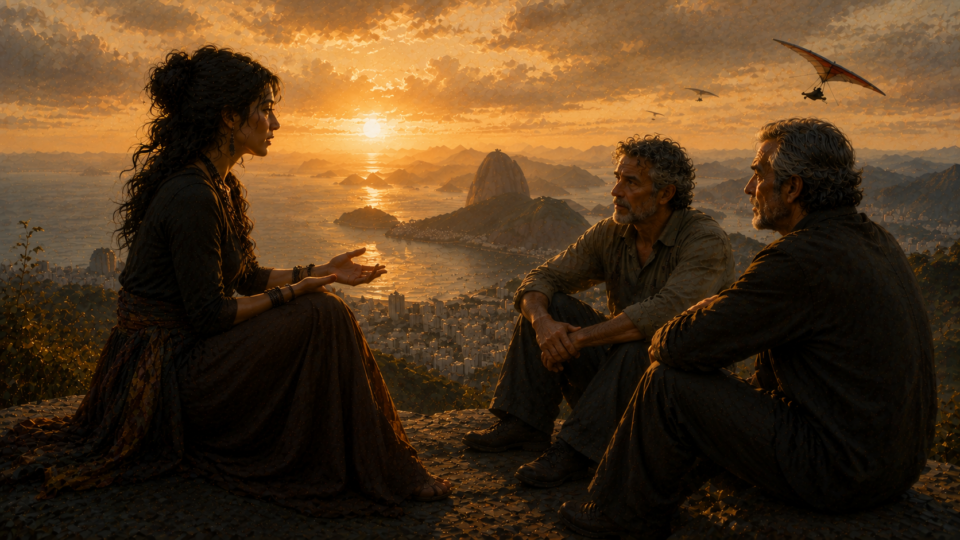
This squandered treasure was the source of Beto’s anguish and sadness. After decades without seeing each other, chance brought us together on the climb up Pedra Bonita, an enormous granite massif rising several hundred meters above sea level, facing the iconic Pedra da Gávea and at the feet of the majestic Atlantic. From the summit, several neighbourhoods of Rio de Janeiro can be seen, allowing one to feel the pulse of this beautiful, enigmatic city, so full of contradictions.
We had studied together in high school. Unlike me, he had chosen to study Law. His dream was to become a great criminal defence attorney. He studied hard and completed excellent internships. He had prepared himself properly for the beginning of his career. After his first few, very promising years, he was caught in the consequences of a misguided and extreme economic plan that froze nearly all the money held in the population’s bank accounts. His clients could not afford to pay his fees, nor could Beto use the savings confiscated by the government to meet his own financial obligations. He endured months of tremendous financial hardship. The bills piled up in direct proportion to the disappearance of his sleep. His father owned a bus company, one of the few business sectors to weather that period of immense difficulty without major problems. Every day, the company received significant amounts of money from ticket sales. The crowds still needed transportation to get to work. Thus, cash flow remained stable and satisfactory. That was when his father, with the best of intentions, invited him to work at the company. He would receive an excellent salary and be prepared to succeed his father when the time came. There was, however, one non-negotiable condition: he would have to give up practicing law and devote himself entirely to the business. Although this relieved the financial pressure crushing him, like someone throwing precious cargo overboard to save a drifting boat from a storm, he had to cast away nearly ten years of study. To run an urban transportation company, his knowledge of criminal law would be of little or no use. With unmistakable sadness in his eyes, Beto told me at the time, “Necessity spoke louder than the dream”.
More than thirty years later, I met him again as I parked my car near the launching ramp for hang gliders, a few meters below the summit of the mountain. He told me that he was married to an incredible woman, with whom he had three wonderful children. After his father’s departure to the Highlands, he had taken control of the company. He lived a comfortable life without any major problems. Yet he still carried the discomfort of a choice he had made before he had even turned thirty. At times, he would wake with a start in the middle of the night, haunted by a line from a poem by Manuel Bandeira: a life that could have been, but was not.
Beto told me that he often sat on the ramp and watched men and women fly as though their hang gliders were natural extensions of their bodies. There was an undeniable fascination in sailing across the seas of the sky, seeing the world from above, and appreciating the silence that exists at great heights. Eventually, he joined the adventure of flying, of launching himself into the abyss and allowing nothing but the air to hold him aloft. There was an indescribable sensation of lightness, impossible to explain to anyone who had never flown. With the company’s management running smoothly, he delegated more and more responsibilities. Thus, he began devoting time to the sport every day before going to work. For him, flying was equivalent to meditation within an impregnable temple. It made him feel good, he explained. I asked whether the anguish of the abandoned dream disappeared during those moments. Beto merely shook his head.
Next, he invited me to fly with him. He assured me it would be an experience unlike any other. I declined the offer. I explained why I was there. I needed to put the house in order. I told him I was heading toward the summit of the mountain. Jokingly, Beto mentioned Cléo, the witch everyone in the city talked about, regarded by the vast majority as nothing more than a character from a famous urban legend. Some people swore they had encountered her on Pedra Bonita. In the same light-hearted tone, knowing that some stories are difficult to believe, I told him I had met her several times. Although I had been unsuccessful in my most recent attempts, I admitted. The encounter had always depended on her, never on me. Beto watched me for a few moments like someone realizing the seriousness behind words that had seemed casual. His solemn gaze asked me a silent question. I nodded to answer yes. I suggested that, perhaps even more than I did, he too needed to put his house in order. There was a room that had been closed for decades and was in need of a thorough cleaning. If he were fortunate enough to encounter Cléo, something I could not guarantee, he would have an experience unlike any other. Beto smiled, uncertain whether he believed what I was saying, but accepted the risk of the adventure.
The poet says that autumns in Rio are equivalent to springs in Paris: incredibly blue skies and delightfully mild temperatures. Without much difficulty, we completed a trail of about twenty minutes to the mountain’s majestic plateau. Before us lay an enchanting view accompanied by an inspiring stillness. I sat facing the sea, closed my eyes, and allowed myself to be guided by someone I am, but whom I do not always allow to participate in my everyday life. Something I have gradually been striving to correct. Beto sat beside me.
After an amount of time I cannot precisely determine, my attention was awakened by the cries of seagulls. When I turned to the side, I found Beto staring in astonishment. Surrounded by birds, twirling at the edge of the cliff, Cléo approached. To hurried eyes, her billowing dress resembled colourful wings. The seagulls departed. The good witch remained.
She settled beside Beto and, in her sweet and delicate voice, asked him, “What did you come here to do?”. Somewhat unsettled, although known as an articulate, intelligent, and quick-witted man, he struggled to answer. Trying to evade the question, he joked that I had invited him to put his house in order. Although he had the broom and bucket in hand, he had no idea where to begin. Gentle and serious at the same time, Cléo advised him, “Begin wherever it bothers you. Some rooms, even those considered small or insignificant, can become so cluttered that they have the power to disrupt the functioning and well-being of the entire house. None of the wounds of the soul can ever be forgotten, but they can always be healed. Some merely require better understanding, while others require changes in posture and action before they will stop bleeding. All healing begins through a more refined way of looking at the experience we have lived through. When the equation results in suffering, it means we have miscalculated life. It becomes essential to redo the calculation as many times as necessary until the result is liberation and peace”.
Beto seemed hardly to breathe. Cléo was inviting him on a different kind of flight from the one he had grown accustomed to taking with his hang glider. There would be no air to sustain him. Consistency with the truth was what would keep him aloft. Otherwise, he would plummet into himself, as he had been doing every day for so long. There was no other way. The witch added, “Without courage, truth cannot leave the ground and soar to greater heights. You will continue losing yourself in postponements, disguises, and escapes. Little by little, very little of you will remain, almost nothing at all. It is not life’s circumstances that do this to us, but the choices we make when confronted by them”.
The businessman allowed the frustration of his abandoned dream to emerge from the dark room of unpleasant and repressed memories. He recounted in detail how everything had happened. He spoke of the hardships he had faced at the time and the temptations he had been unable to resist. He had chosen the easier path, yet it was a path without heart. Because he had lacked the strength to deal with the difficult circumstances pressing down upon him, he had denied his own destiny. He lived a comfortable and peaceful life, yet he carried within himself an emptiness he could neither forget nor escape. If it is empty, why does it hurt? he wondered. Overcome with emotion, his hands trembled. A tear exposed the pain of a feeling repressed for more than thirty years. He ended with a question he believed had no answer: where do abandoned dreams go?
Cléo looked at him compassionately and explained, “Dreams are never truly forgotten. Dreams do not go anywhere. They remain inside us, bleeding. We deny them, lie about them, or repress them. We justify abandoning them with clever arguments. Excuses may offer some consolation, but they never refine or improve anyone’s life”.
She paused before adding, “Abandoning a dream can mean seriously giving up on oneself. It is equivalent to leaving a piece of who we could have become by the side of the road. In the place of what was suppressed, emptiness arises”. Then she concluded, “It is not the emptiness that hurts. It is the piece that was torn away, because it was not a bad or diseased part. It was the part that would have made a difference, but it was thrown away. What hurts is the truth understood by consciousness, yet repressed by a mind that refuses to confront its mistake and correct its course”.
Beto shook his head. He argued that he had been pressured by historical circumstances. He had accumulated many debts. At the time, great uncertainty about the future plagued the population. Accepting his father’s invitation and the conditions he imposed had been an urgent necessity. He had no choice, he insisted. Cléo corrected him: “We always have choices. You made the one you believed was appropriate at the time. There is nothing wrong with that”. Then she reflected, “Some people are perfectly comfortable allowing themselves to be carried along by the forces of circumstance, like boatmen surrendering to the strength of the currents. They never know where they are going. Their innermost will does not serve as their rudder. They sail wherever the tides take them. For them, any harbour will do as a destination. They live as supporting characters in stories without a plot. Yet there are those who refuse to be less when they could become more. They need to be the authors of their own stories. For them, the dream makes all the difference. I am not speaking of fame or fortune. I mean the light that refuses to go out within their hearts. Even if no one notices, approves, or accompanies them, they know the importance of the path and the destination they want for themselves”. She looked at him seriously and asked, “What kind of boatman are you?”
The businessman remarked that, although he enjoyed good health, he was already past sixty. A few weeks earlier, he had been invited to a ceremony at the university commemorating the fortieth anniversary of his graduating class. Among his former classmates were lawyers, judges, prosecutors, and even a few appellate judges. They were talking about retirement. Starting over now made no sense. The train had already passed. That route no longer existed. The destination was beyond his reach. He had been defeated either by himself or by the forces of circumstance. It did not matter which. He had resigned himself to it.
Cléo argued, “All comparison is insane and absurd. No one is the same as anyone else. Therefore, no two paths or stories will ever be alike. Circumstances certainly do not prevent us from reaching our destination. Difficulties, problems, and obstacles are inherent in everyone’s life, just as storms tear sails, rocks force us to adjust our course, and cracks in the hull send the boat to the shipyard at different times for the necessary repairs. Bad weather and unforeseen events are common occurrences on any crossing. Some treat them as impediments, while others use them as opportunities for important growth. This defines how each boatman sails through life”.
Beto repeated himself, as though the witch had not understood or perhaps to emphasize a fact that could not be disregarded: he had graduated forty years ago. That was a very long time. Cléo smiled, shrugged, and reminded him, “Moses led the Hebrews through the desert for forty years. He could have completed the journey in a few months. Yet he understood that they were not ready to begin a new and valuable cycle. He did not waste time, nor did he lose his way on that journey. He took a long and indispensable pause to prepare those people, thereby preventing one of the most important chapters in History from being poorly written”.
She looked at Beto affectionately and reflected, “Were you ready back then to be the lawyer you wanted to become?”. Beto confessed that he had been a very immature and reckless young adult, with little mental clarity and no emotional balance. He was imprudent, impulsive, and rash. Although he had studied hard and acquired a great deal of knowledge, he admitted that he had not been ready. Practicing criminal law requires impeccable ethical conduct so that the thin line separating the criminal defence attorney from crime itself is never crossed. Had he continued, this might have seriously compromised his career. Now, however, he considered himself close to existential maturity. Much had changed. The many experiences he had lived through over the decades had contributed greatly to this understanding. The witch’s lips curved into a beautiful smile as she remarked, “Blessed are those who understand why they are crossing a desert. Do not curse it or lament it. Deserts are not insurmountable circumstances, nor do they steal dreams. They exist to forge the most beautiful destinies”.
The businessman admitted that he was uncertain whether it made sense to resume his career at a time when everyone who had graduated alongside him was retiring. It seemed incongruous to move against what he called the natural course of life. Cléo furrowed her brow and questioned him in rapid succession, “Why would it be foolish? What prevents you from beginning when others are stopping? Is your point of reference your own truth or the lives of others? If you do not assume authorship of your own story, who will write it for you?” Then she added, “The natural course of life is evolution, which each person undergoes in their own time and in their own way, because everyone’s needs are different”.
She paused before asking her final question, “Do you understand that it is not circumstances or external difficulties that prevent you from reaching your intended destination? Each person has their own desert to cross. Some are longer and take more time than others. There is nothing wrong with that. The mistake lies in thinking that the desert is crossed only through the world outside, while forgetting the stretches that must be travelled through the universe within”.
Before Beto could say a word, the seagulls approached. Flanked by the birds, as though taking part in a majestic, orchestrated ballet, the witch twirled along the edge of the cliff until she disappeared into the distance. We remained seated in silence for a long time. There was no hurry. Each of us had a house to put in order. From time to time, I opened my eyes and saw Beto watching the bird-men fly. Without saying anything, I thought that someone who has the courage to launch himself into the abyss with nothing but his own wings to keep him aloft should have nothing else to fear. It was an image imbued with powerful symbolism. Whoever had the courage to leave something so precious behind must also have the audacity to reclaim what had always belonged to him. Nothing is more important than safeguarding one’s own destiny. It was late afternoon when we descended the mountain. Without revealing anything, Beto gave me a tight embrace and thanked me for that day. He said it had been pivotal. We said goodbye, and I did not see him again.
Nearly three years later, I called the accountant who provided services to the publishing house. A colleague of mine, also a businessman, had been charged with an alleged tax crime. I asked whether he knew a good lawyer he could recommend. The accountant told me about a professional who, although he had only recently returned to practicing law, was doing excellent work in that particular field. He gave me Beto’s name and telephone number. That was when I learned that Beto had handed over the management of the company to one of his sons, devoted himself to studying the new legislation, and only then returned to legal practice. Yet this was no ordinary return. In order to move ethically, clearly, and steadily through the laws and courts, the lawyer had needed to wait for the man within him to reach maturity. Some deserts are longer, and some crossings require more time. Without question, life is a teacher: circumstances refine travellers, they never prevent them from reaching their destinies.
Translated by: Cazmilian Zórdic
