
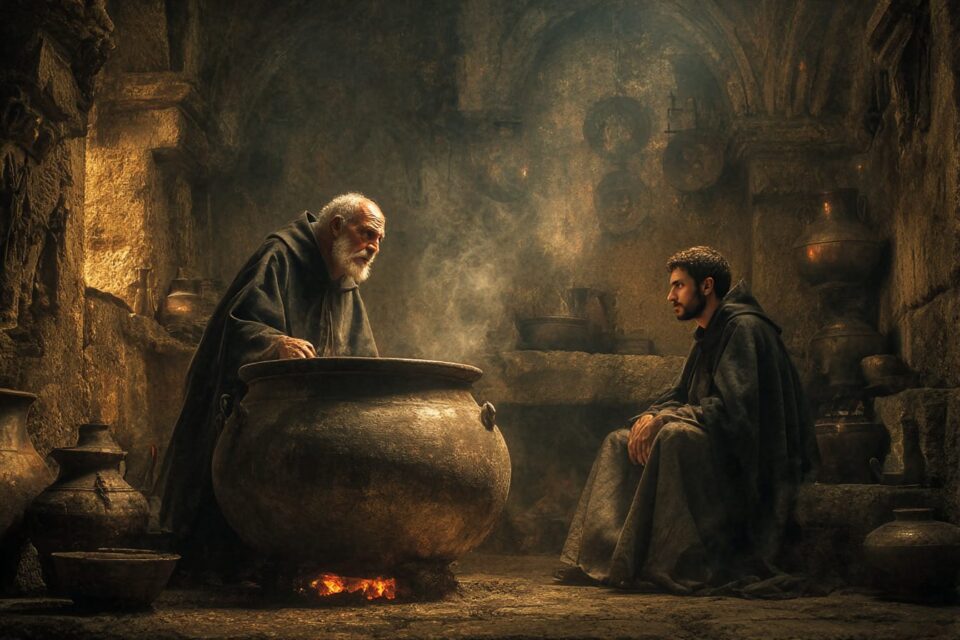
I had been strangely tired in those days. Even in the morning, right after breakfast, before my duties at the monastery, I already felt exhausted, wanting to lie down. There was a discouragement that doctors could not identify. Clinical exams showed nothing wrong with my health. I loved the study periods at the monastery for all the good they brought me. Throughout the year, I would wait for those weeks of learning and renewal. Pivotal transformations in my life had their origins in that place. However, that time, everything was different. Within me, there seemed to be neither joy nor pleasure.
I even considered the end of my cycle at EOMM , Esoteric Order of the Monks of the Mountain , a brotherhood with which I had been associated for many years. The idea lost its meaning when I recognized the greatness of the purposes behind the activities carried out there. That morning, I asked Heitor, the Argentine monk, to replace me in the classes on The Sermon on the Mount, a text contained in the Book of Matthew, a mandatory course given to novice monks, the primary axis of all other studies at the monastery. Although I loved that sacred text for the clarity it revealed, at that moment I lacked the spirit to teach the classes. My mind seemed clouded. My strength, drained. My reasoning was dulled, without the slightest condition for the indispensable progressions and expansions of consciousness. I sat in the cafeteria to try to understand what was happening to me. Almost at the same time, the Elder entered, as we affectionately called the oldest monk of the Order. He took two mugs of coffee, without asking permission, placed them on the table, and sat in front of me. As if he knew how I felt, he stated in his usual gentle and unhurried voice: “You do not know how to think. This ends up draining your vital energy. When it happens, the days lose their colour. It is necessary to learn to think urgently. Otherwise, you will be crushed by your own thoughts.”
I smiled with a certain dose of irony. Everyone thinks. We have always thought. We think all the time. We think even when we do not want to think. If there was something I did not need to learn, it was how to think. The good monk corrected me: “I am not referring to the uninterrupted flow of thoughts, something common to all people, but to the way we deal with each one of them. That defines the illnesses or the health of the soul.” Immediately, my sarcasm disappeared. I realized the importance of that conversation. Noticing my interest, he continued: “Every day we are invaded by torrents of ideas from the most diverse origins. Recent and distant events, good and bad memories, achievements and frustrations, expectations and assumptions, elaborated or prefabricated ideas.” He fell silent for a few moments, as if searching for a metaphor to help my reasoning, and said: “Thoughts are not ready-made dishes. They are ingredients. When used and mixed without criteria or control in the kitchen of the mind, they create chaos in the restaurants of the world, where we hold our existential suppers, whether each one with oneself or in interpersonal relationships. Without a good cook to select, prepare, and harmonize the ingredients, the dishes will have very unpleasant flavours. At times, they may poison.”
I asked him to explain further. The Elder was generous: “Ingredients cannot be used without due care. One must clean the fish, remove the pineapple’s peel, and measure the salt. Some need to hydrate; others must wait for ripening. So it is with thoughts that have, among other origins, the results of experiences arising from relationships and events. All of them generate conclusions, which serve as the basis for the formation of beliefs. Do not narrow the concept of belief to religion. Understand belief as everything we accept as true. At times, we are right and have a quality ingredient to prepare good dishes. We feast on the delights of life. At others, we are wrong and make use of rotten ingredients. The result is disastrous. The days turn sour.”
The good monk added: “Beliefs, in some cases, originate from lived experiences, at the extreme limit of each individual’s perception and sensitivity. An internal elaboration may be good or bad, bring clarity or cloudiness, depending on each person’s capacity. It is common for the very same situation to be understood in several ways by different people.” He took a sip of coffee and continued: “In other situations, belief arises from an external idea that reaches us ready-made and we accept it as true; whether by logic, serving to scale tones of understanding, or by convenience, as a way to keep us comfortable in a place we do not wish to leave. Likewise, uncomfortable thoughts are received as invitations to transformation by some, while by others they are immediately rejected for appearing malformed. Thus we choose the ingredients we use in our spiritual meals. We are the exact reflection of the truths we believe. They shape our behaviour and our choices. They forge character and destiny. Progress or decline, movement or stagnation, joys or sorrows, achievements or frustrations, encounters or escapes, each person lives the reality possible at the last frontier reached by the truth they have built within themselves and for themselves.”
Then he concluded: “In short, everything begins and ends with learning how to think. Poorly selected or poorly constructed thoughts lead to mistaken choices. The opposite also applies: good thoughts and well-elaborated ideas serve well-being and evolution. This defines the sweetness or bitterness of life and, consequently, the willingness or discouragement along the journey. All power and balance reside in the mind.”
My eyes asked him to deepen his reasoning. The Elder understood the unspoken words and reflected: “From there, it becomes easy to understand that existential storms are directly proportional to the mistakes in the truths we believe and to the errors made in the conclusions about the situations that involve us. The opposite also applies to people who are already able to bring a radiant sun into their hearts. It is necessary to create good conditions in the mind so that good thoughts find reasons to stay. By habit , nourished by a type of pleasure that, as long as it remains unconfessed, we will not be able to tame , we are attracted to tragedies. This explains why the media focuses on this kind of news. Tragedies, in turn, create favourable conditions for bad thoughts to direct disastrous choices and behaviours. However, habits do not translate anyone’s essence. Our essence is light. Habits arise from sociocultural influences and conditioning, shaped by ancestral inheritances built upon conflicts, disputes, fears, guilt, resentments, and other behavioural vices linked to feelings of inferiority , such as pride, vanity, greed, envy, and jealousy , which, to a greater or lesser degree, still integrate us, compose us, and are part of our personality. On the other hand, habits can also be changed, being reshaped from a new posture with which the individual decides to relate to themselves and to the world.”
I asked how much of an individual is subject to transformation. The Elder replied: “As many layers, disguises, deceptions, and rough edges that hide the essence as need to be discarded and rebuilt. No one is born ready. Yes, everyone has habits, behaviours, personalities, and temperaments. However, contrary to what many imagine, these characteristics are not static or immutable. In truth, they were acquired along the road of time. Therefore, they are transient and dynamic. It is essential that this be so, otherwise they would serve nothing in the process of evolution which, by principle, demands infinite changes. In the sequence of continuous transformations, little by little, consciousness matures and acquires the conditions to express its originality, the root of individual beauty, which reveals the aspects of being and living that make us unique, generating authentic feelings of peace, dignity, and joy, even during the difficult and turbulent moments of our days. The origin of this genuine existential revolution is in accordance with the ability to select ideas and elaborate experiences to use them in favour of one’s own evolution. Everything and everyone around benefits. Learning how to think is essential if we are to love more and better.”
The Elder reflected: “When one does not learn how to think, bad thoughts overlap the good ones, corrode the mind, crush the individual, and sour reality. They install a dark empire of bitterness and suffering. The best thoughts are banished to the repressed consciousness. They remain exiled in the unconscious. Mistakes, misunderstandings, conflicts, abandonments, resentments, demands, and confusions become increasingly common in daily life. Little by little, we lose the best that dwells within us, we become unbelieving and irritable, tired and discouraged. Love, joy, hope, and faith are left homeless. The house becomes empty of good residents. Remember that each person lives within themselves with the thoughts they have chosen as company. Thoughts build and destroy inner universes.”
The good monk returned to the kitchen metaphor to clarify my question: “It is necessary to remove the peels of superficiality to find the deep meaning of events: there resides the sweetness of love manifested or the sourness of love suffocated. Behind the truth of spoken words lies the unconfessed truth, still misunderstood. This reveals much more than the former. There is more about who we are in what we deny and silence than in what we say. So it is with everyone. But do not worry about discovering these things in others. First, take care to find them within yourself. That will be your wealth and your power.”
I used the same analogy to ask whether there was a recipe for good thoughts to once again prepare good dishes to be served at my existential meals. He nodded yes and detailed it: “It is necessary to cleanse from others’ words the meanings that do not belong in them, which so often annoy, deceive, mislead, steal energy, and thus manage to pull us away from our axis of light. Very little of what is said has to do with us. Likewise, almost nothing of what we say has to do with others. When someone speaks, they express a viewpoint or a feeling, not necessarily the truth. They show reality as they understand it, the abysses they see and the bridges they have crossed. Some abysses pointed out across the world are often nothing more than inner voids. Likewise, although they serve many, not every bridge will support everyone’s crossing, for they lead to places many do not wish to go. When someone remains silent, they leave a void that cannot be filled with assumptions. Only patience and respect, indispensable to the maturation of truth. Remember that slow cooking is essential to refine the flavour of the finest delicacies. The high flame of passions does not serve the delicate texture of love and wisdom.”
He took a sip of coffee and concluded the recipe: “Measure expectations and worries in minimal quantities, so that life may never lack the honey of dreams, a dessert that must appear on every menu. On the other hand, make generous use of sensibility, as a safe way never to slip into the excesses typical of daydreams nor into the scarcity caused by fears, guilt, and resentments, always so bland, sour, and unnecessary. Likewise, one must not confuse the balancing and strengthening mechanisms of dignity with the coercions typical of moralism which, upon closer analysis, always hide immoralities marinated in base feelings. Above all, good thoughts sustain good attitudes, even if no one understands, agrees, or wishes to accompany us. Never forget: your conscience is enough to validate and authorize your movements. However, have the maturity to deal with the inevitable consequences. Whatever they may be.” He shrugged and concluded: “A kitchen commanded by a chef will always offer a menu full of marvellous dishes. Without a good cook, it will be a catastrophe foretold.”
I asked who the chef in the kitchen of the mind would be. The good monk promptly answered: “The conscience.” I asked how to know or ensure that the conscience is always in command. The Elder clarified: “We cannot confuse ourselves with our thoughts. This is a common and vulgar mistake. Ideas of the most diverse kinds pass through the mind every day. We all have good and bad thoughts; there is no way to avoid them. However, we have the power to decide which ones we will use as ingredients for our meals. Therefore, even when besieged by catastrophes, disappointments, betrayals, frustrations, or news about the sewers of the world, we have the choice to discard ideas that serve only to sour the dishes.” He furrowed his brow and added: “Whoever ignores or does not recognize this power is still a puppet of circumstances. The owner who does not understand what happens in the kitchen is far from becoming the true master of his own restaurant. No complaint will be valid if the patrons are of poor character or if the meals remain contaminated.”
He went on: “Refuse thoughts that do not serve the task of goodness and of healthy personal transformation. But first, identify their origins and motives. That is, where they came from and for what reason. Only then will it be possible, little by little, to reduce their presence, until they become insignificant or, before that, until you are able to discard them more and more quickly.” He sipped another mouthful of coffee and suggested: “Let remain those that sustain virtues and expand truth, for they are indispensable to emotional balance, mental clarity, and therefore essential to the refinement of choices and to well-being. Even if the world, shouting, demands the adoption of an idea, embrace your conscience if, in a whisper, it suggests a different posture. An original menu is created only by using unique recipes.”
Finally, the Elder addressed the issue of feelings, the seasonings that enhance or spoil the flavour of the dishes: “The relationship between thoughts and feelings is symbiotic. There is a powerful, both healthy and dangerous connection that feeds them back into one another. Dense emotions have the power to spoil good ideas. Subtle feelings have the strength to dissolve bad thoughts. Just as salt enhances flavour, feeling well refines thinking well. To understand the processes of the mind, it is necessary to understand the movements of the heart. Until that happens, we will live clumsily trying to manage the consequences of incessant mistaken decisions, without admitting that we were the ones who caused them. We will continue in the long and painful vicious circle of transferring responsibility, cursing bad luck, and lamenting the injustices of the world in a behaviour that keeps us in immaturity and drains our will to live.” He shrugged, reminded me of the tiredness and discouragement that had been weighing on me without apparent explanation, and ended the conversation: “Spoiled ingredients contaminate the dishes; the diners fall ill. Good food restores health. This applies both to the body and to the soul.”
The Elder claimed he needed to prepare for the lecture that afternoon and stood up. Recipe given, conversation ended. For him, not for me. It was necessary to arrange those ideas on the shelves of the mind. Only then could I make use of the power that, although it had always belonged to me, I insisted on wasting. An inner movement that would not only restore authorship over my direction, but would also allow me to recover the joy and enthusiasm lost in the dark alleys of my misunderstandings. With his slow and steady steps, I watched him walk until my eyes could no longer see him. In silence, I thanked him for yet another recipe. Transforming it into the finest spiritual suppers was the task that belonged to me. Provided, of course, that I wished to become a good cook.
Translated by: Cazmilian Zórdic
