
I am a lover of sunny mornings, but I confess that a starry sky or a night with a waxing moon brings me an indescribable inspiration of transcendence. That early morning, as I walked from the train station to Loureiro’s workshop, the shoemaker who loved red wines and books of philosophy, through the crooked and narrow streets of the small and charming town near the mountain that sheltered the monastery, I had as my companion a most beautiful full moon that recited poems impossible to translate. Those were days of excitement, concern, and anxiety. Moments like these tend more to cloud the mind than to clarify it. I had recently gone through a pivotal transition. After decades as an advertising professional, I had left behind an important professional chapter to begin a career as a publisher. The business moved forward with the difficulties common to young enterprises, which, like any immature being, required the experiences offered by dark nights not only to mature, but also to allow the purest originality to blossom.
I am like steel forged in fire, cry out the warriors. I am like clay shaped in the potter’s hands, whisper the monks. The former rely on strength to overcome obstacles, while the latter choose gentleness as the means to pass through them. Warriors fight bravely to survive the dark nights. Monks simply navigate them. For the former, the nights are enemies; for the latter, valuable teachers. They do not exist to hinder, but to teach. I was a warrior. I moved through passion. The days were filled with battles and, for that reason, remained unfit for navigation.
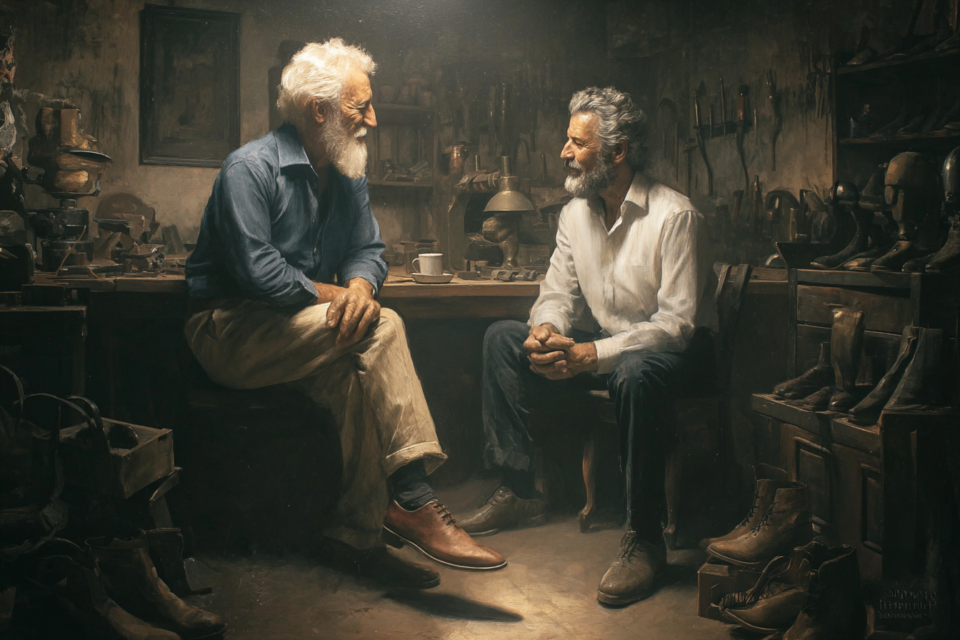
The day was still far from breaking when I entered Loureiro’s workshop. I found him crafting a beautiful burgundy leather bag, with the same mastery with which he stitched ideas together. I was welcomed with a sincere smile and a tight embrace. The elegant shoemaker wore a light blue linen shirt, with the sleeves rolled up to the elbows so as not to interfere with the work, and finely tailored khaki trousers. The leather shoes were of his own making. His white beard was short and neatly trimmed, unlike his abundant hair which, though also white, was rebellious and dishevelled. Without delay, he prepared a pot of fresh coffee and placed two mugs on the heavy wooden counter. The conversation flowed with the usual naturalness of two friends who connect topics as if they were stretches of endless roads.
Despite the difficulties inherent in new businesses, the publishing house’s performance exceeded the best expectations. Thanks, above all, to the exceptional work of a couple. He, a writer; she, an illustrator. They had translated into the universe of graphic storytelling the book The Voice of the Silence, a classic of Theosophy by Helena Blavatsky. By changing the format of the work, they made it accessible to a larger number of readers. The various teachings drawn from Buddhism by the writer became easier to understand. The poetic and somewhat hermetic language used in the original text was replaced by images of action. Although the text became more direct, it exposed in a simple way some fundamental practices of enlightenment that had until then been misunderstood by much of the Western public. The success was enormous and immediate. I had acquired the international publication rights. The experience in some countries of Latin America had been successful. It was time for the big step: the Northern Hemisphere.
I was extremely excited. And somewhat worried as well. It so happened that, in the wake of the success, the authors received a fabulous proposal from a powerful multinational company to change publishers. This company was, in fact, a huge conglomerate of publishing houses, present in almost every corner of the planet. The couple, of course, loved the idea and the offer. The multinational had undeniable publishing power and reach, something unthinkable for my small publishing house. Yet it was my chance to grow. I was passionate both about my business and about the literary universe. I did not even consider the idea of terminating the contract. Even if they had offered me a good indemnity, in the long run my profits would far exceed the conglomerate’s offer. Moreover, I wanted to produce the edition of a work that had been discovered and had taken shape within my small publishing house in my own way. That enchanted me and had made me fall in love with the entire process, from conception to realization.
With the conglomerate, the couple would quickly make a great deal of money. Like me, they had dreams. What separated us was the matter of time. They were in a hurry. It was impossible for me to follow the new rhythm proposed to them. As a result of this impasse, I had become the defendant in a lawsuit whose purpose was to force the termination of the contract. I hired a renowned law firm so that my rights would be respected. The law was on my side, they assured me. Although they guaranteed me enormous chances of success in this legal battle, a favourable verdict was not an absolute guarantee. Worries and uncertainties surrounded my days. In two months there would be the first hearing. My nights were restless. For the moment, I was still managing to resist anxiolytics. I did not know for how long.
I recounted these facts to the shoemaker even before taking the first sip of coffee. Anxiety overflowed in my rapid speech and impatient gestures, as if time were an enemy for taking too long to fulfil my wishes. Loureiro listened attentively without any interruption. At the end, he commented: “The sum of all your worries, insecurities, and fears is incapable of altering your destiny. Do not dwell on them. They are of no use. Only your actions have such power. If you do not learn to deal with the adversities inherent to existence, understanding the educational aspects they offer and how to react in the best possible way, you will end up crushed by the avalanche of events that fall against the direction of your desires and truths”. I argued that I was facing a difficult battle that could indeed define the future of the publishing house. I was passionate about what I did and was determined to make the company prosper. I also said that passions were powerful levers for progress and struggle. I affirmed that I would emerge triumphant from that fight. The shoemaker shrugged and remarked: “You will never win until you understand the mechanisms of action of the enemy”.
I asked if he knew something about the couple that I did not. Loureiro shook his head and clarified: “I am not referring to the couple. I am talking about passions”. I asked him to explain better. The shoemaker reflected: “A brilliant French alchemist wrote that passions are like horses. If tamed, they are useful and valuable. When wild, they throw their riders. If you do not master your passions, you will become their slave until nothing authentic remains in your life. Neither your wills nor your desires. No route or direction. Nothing will belong to you. Passion will become your owner, making you nothing more than a riding animal”.
He took a long sip of coffee before continuing: “Passions are part of human nature. Therefore they are neutral, neither good nor bad at first. The way we experience them establishes the positive or negative pole. When mastered, they are well used and serve to propel the most beautiful achievements. If misunderstood, they dominate the individual and crush him in a sad process of self-destruction”. He paused briefly and added: “The problem with passions lies in the excesses linked to desires, to wanting without measure, to unrestrained wills, or to extravagant needs”.
He placed the mug on the wooden counter and continued: “It is at this point that we trample the rights of others with the same insensitivity with which we begin to treat our own dignity. We act toward people in ways we would not like them to act toward us if the roles were reversed”. I interrupted to ask how it is possible to identify the domination of passions over our consciousness. The shoemaker clarified: “Notice whether the mind is creating twisted reasoning to justify the absence of virtues or to alter the truth, so that choices may adapt themselves to derailed passions. One of the evident signs of the supremacy of passions over inner truth occurs when we want to become the owners of situations so that, at any cost, our wills and needs prevail over those of the other people involved. Passions that run off the tracks of reason and justice foster selfishness, jealousy, greed, fanaticism, manipulation, coercion, blackmail, lies, among other behavioural vices. Hatred, resentment, and bitterness are the feelings that follow uncontrolled passions. We lose what is best within us. We give space to the shadows to the detriment of the light”. Then he concluded the reasoning: “Truly free individuals strive only to be masters of themselves. The choices concerning their own lives are enough for them. For that, they keep their passions under control. Believe me, it is no small thing. Events, as well as the truths and wills of others, are merely tides, sometimes favourable, sometimes contrary, through which they navigate with love and wisdom, without any resentment”.
I argued that this speech did not apply to my case. There was a contract guaranteeing me the international publication rights. When I decided to bet on that work, their manuscript had already been rejected by several publishers. It could have failed and I would have lost the investment made, something common in the literary market. I had not forced them into anything. On the contrary, perhaps I had been the couple’s last chance. It was even possible that they would have abandoned the book if I had not recognized its value when no one else cared about them. It was not fair to let them leave at such a promising and decisive moment for the business. Loureiro drew me into the threads of the philosophical bow with a question: “Why keep them tied to you?”
I became irritated. I asked if he did not perceive the ingratitude and injustice of the couple in wanting to break the contract after I had brought them into the spotlight. They would never have received any millionaire offer if I had not edited the book so carefully. The shoemaker tapped the wooden counter with his index finger to emphasize his words and remarked: “I am not referring to money. I am speaking of freedom, dignity, and peace. Do not worry about anyone else’s mistakes or successes. Focus only on your own. It is not up to you to give direction to the actions of others. Take care to do things differently and better, in a way never attempted. If you know how to think, you will understand that it is not the choices of others that define the joys or the bitterness of your days. Life delivers to each person according to their actions. Not a gram more, not a gram less”.
I commented that agreements could not change just because reality had changed. Loureiro unsettled me: “Why not?” When I hesitated to answer, he argued: “Without a doubt, keeping one’s word is very important for the security of relationships. When it does not manifest as pride and vanity, it is an exercise of dignity, freedom, and peace. However, relationships also require other qualities to remain healthy. It is natural for the will to change when the gaze changes. So why maintain a model of relationship that no longer serves and no longer pleases?” Once again, I had no answer. The shoemaker reflected: “There will never be a good reason to force someone to stay who wishes to leave. Wanting to leave reveals someone’s perspective about a situation; not opposing the departure reveals a sublime manifestation of respect on the part of the other person. If there was ingratitude or injustice, the problem is not yours but theirs. The evil that most affects us does not come from others; it is the one we practice. Not forcing someone to stay who wishes to go, regardless of the promises made, is also an exercise of dignity, freedom, and peace”.
I asked whether he considered it wrong for me to fight to maintain the contract. After all, it had been the agreement from the beginning. Loureiro reflected: “You will be right like many. But if you do differently, you will be right like few”. I said I did not understand. The shoemaker explained: “There is nothing wrong if you decide to fight to keep the contract. That is what the laws, contracts, and businesses determine. It will be financially very good for the publishing house. However, you will force them to walk by your side against their will. Something that is not good for anyone. If, on the other hand, you let them go, you will end the jailer-prisoner relationship that was established the moment perspectives and desires changed. In return, you will lose a considerable amount”. He shrugged and concluded: “The price of a mastered passion is never easy to pay”. He frowned and increased the seriousness of his tone: “It is up to you to decide what you want to gain and lose”.
I asked the reason for such difficulty in mastering passions. Loureiro answered promptly: “Mastering passions requires abnegation, a rare virtue”. My gaze asked him to say more about the matter. The shoemaker understood: “Abnegation is the virtue that changes the measure of existential priorities. Instead of using the ruler of material achievements to measure the success of a life, one begins to use spiritual achievements as the parameter of success and victory”. He emptied his mug and concluded: “Right and wrong, just like good and evil, have many layers of understanding. Very few are ready to go to their deepest layers and then emerge with a light of almost unknown intensity and, for that reason, little recognized. Only the selfless are allowed such a plunge within themselves”.
Dawn was arriving. The rays of the sun entered the glass door of the workshop without asking permission or offering apology. My ride , the pickup truck that every day delivered fresh bread to the monastery , would soon depart. There were many new ideas to metabolize. Some were almost ready, others would need more time to mature properly. I needed to think. There was a dilemma, but also an opportunity. I needed to prepare myself if I wished to go to unknown places within me. Only then would it be possible to move through the days in a way I did not yet know.
Translated by: Cazmilian Zórdic
