
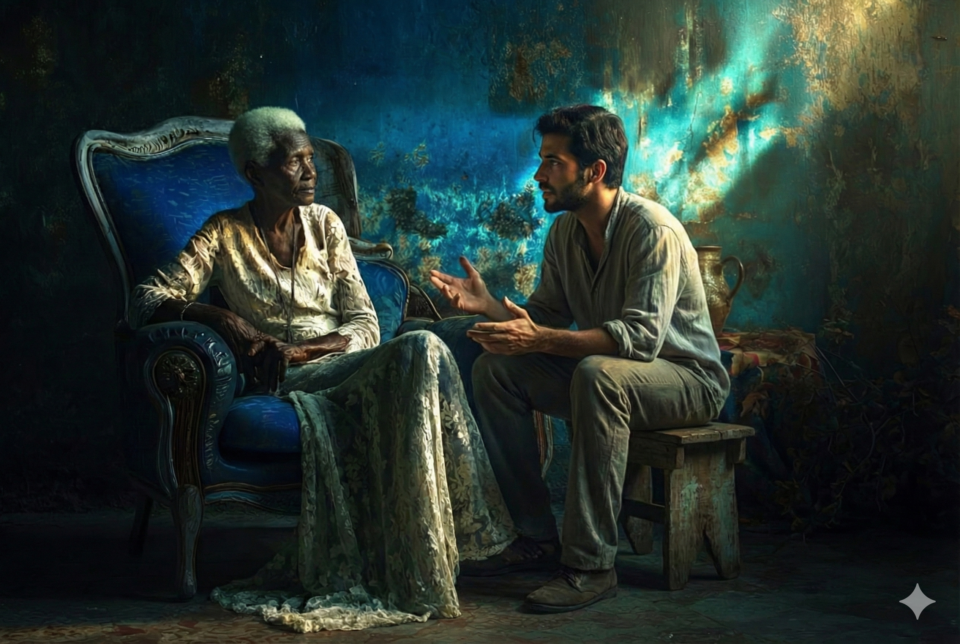
This story happened almost a couple of decades ago. Fausto, whose godfather I was, the son of one of my best friends, had graduated in Civil Engineering not long before. Contrary to his expectations, his professional progress had proven slow, quite different from what he had imagined, as he told me when he sought me out. The jobs offered were far below his capability. They were positions and roles in which he would never have the chance to display the talent he possessed. His paths were closed. Impassable. All attempts had proven fruitless, without any apparent good reason. Something abnormal was happening. Fausto remembered the stories I used to tell about Aunt Francisca, the faith healer from Madureira. He asked me to take him to her. He was certain the good lady could help him. I hesitated for a few moments, unsure whether that was truly what he needed most at that time. However, since prayers can only do good, I granted his request.
Rio de Janeiro is filled with fantastic characters who seem to move between reality and fiction because of their incredible personal traits. Aunt Francisca was one of those people. A resident of Madureira, one of the city’s most iconic neighbourhoods, cradle of brilliant artists and tenacious workers, the faith healer lived in the same simple house where I had first met her as a boy, led by my father’s hand, worried about that child who seemed to inhabit several distinct worlds at once. Despite her humble habits and conditions, she possessed a cultured and refined way of expressing herself, making prose fall in love with poetry. Always with her doors open, she welcomed distressed souls who could not understand the apparent incoherences of life. I watched many people leave there with a light in their eyes that had not been there when they arrived. When they wanted to pay for the prayer, she would offer a sweet smile, point with her chin to the altar and say, almost in a whisper, sincerely: “Give thanks to Our Lord Jesus Christ, to Him all honour and glory. To me, nothing is owed”.
As usual, I found her seated in the worn blue armchair, the colour of Our Lady’s mantle. I introduced my godson to her. With a gentle gesture, she suggested that Fausto sit on a small wooden stool in front of her. At the elder’s request, I sat beside them. Without needing to be asked, the young engineer, distressed, explained the unlikely difficulties that prevented him from climbing the professional steps he deserved. He asked her to intercede with the good Spirits. His paths were closed. It did not seem natural to him to face so many barriers and obstacles. Then he listed several of them. The faith healer listened with infinite patience, without any aside or interruption. At the end, she smiled tenderly and said: “First of all, never forget that God, regardless of how you understand Him, does not favour the supplication of one child with more attention or interest than that of another. There is no distinction. Take care only that your request is in accordance with your needs, never with your desires. Also make sure that it is imbued with justice and love. Under these conditions, everyone is answered. Never according to worldly imagination, always in favour of learning and spiritual evolution”. She made a brief pause before clarifying another aspect of utmost importance: “No serious place or person will promise what lies outside their sphere of realization. No one has the power to open another person’s paths”.
Fausto objected. There were churches and temples, as well as gurus and religious leaders, who guaranteed such a feat. Aunt Francisca corrected him: “You must have misunderstood or they failed to tell the truth. There are various places and people capable of offering the indispensable tools for that purpose. However, the work is personal and non-transferable”. She looked at him with compassion and continued: “Although, as far as possible and reasonable, everyone should help everyone else, paving the path and the consequent advance are individual tasks. And it must be so, otherwise we would remove from life its pedagogical function of fostering the indispensable transformations so that we may become different and better people”. He objected again. He argued that he was traveling on an impassable road. He was hardworking and intelligent. He had studied a great deal. He harmed no one. It was necessary that another existential road be granted to him, one in which there were means to achieve what should belong to him by merit. The faith healer shook her head no and explained: “Whether you understand it or not, everything is as it should be. To each person belong the exact pains and delights of the days they cross”. Then she declared: “If the road is bad, do not lament or complain. Simply change your way of walking. Otherwise, the path will remain the same. No one will be able to help you”.
The young engineer took a deep breath to contain his impatience, as if to say he had not gone to Madureira to hear those words. Before he could speak, Aunt Francisca proposed a prayer to calm his heart: “Emotional imbalances cloud mental clarity. That is why prayers and meditations, as well as good readings, have great value. When reality goes against the unreal image we have of who we are, we are left destroyed. Knowing yourself more and better is the foundation of truth and virtue. They are the pillars of personal reconstruction. The opposite of this leads us to imbalance, stagnation and suffering, without us being able to understand that we have caused the effects that surround us and, consequently, we end up planting a flag in an undesired destiny”. He fell silent so that she could bless him. After a few minutes, nothing had changed, except for a small yet clear sense of serenity in Fausto’s features. A sign that his listening was a little less obstructed.
More out of courtesy than conviction, Fausto asked how the faith healer could help him change his way of walking so that, at last, the paths would open. With the generosity and patience that were typical of her, the faith healer explained: “The one you are today has brought you to the present existential moment, but does not have the power to take you forward. Who you are has exhausted the capacity for movement. To move ahead, you will have to deconstruct yourself so that a new internal construction, different and better than the current one, may rise. No one changes the way they move through the world and life without modifying their own behaviour. Understand behaviour as the way of acting, reacting and making choices. Habits do not define anyone’s essence, they only demonstrate the current level of consciousness, which can always rise, if the individual has the firm determination to change their way of looking at and dealing with themselves. All habits, however old and deep-rooted, are subject to transformation, if the individual understands that these usual behaviours prevent the flourishing of the best that exists within. Life always responds in the exact rhythm or lack of rhythm of our steps”.
The engineer’s eyes showed interest. Aunt Francisca went on: “To change behaviour and, therefore, one’s own story, it is necessary to transform the way of thinking. Thoughts define routes which, in turn, determine destinies. The mind is the window through which the soul observes, understands and manifests itself. Subtle or dense thoughts have the power to open or close windows, to leave the mind clear or clouded, to allow consciousness to expand or to retract. Thus, thoughts have the power to widen or narrow reality – the dynamic perception that each person has of the world and life – the place where paths present themselves or hide. Pay attention to the kind of ideas that occupy your mind most of the time. There is no way to prevent corrosive thoughts from invading us, but we are able to let them pass without allowing them to take root. Almost all storms have them as seeds”.
The young man argued that, from time to time, he made commitments to change with himself. He said he knew the importance of constant transformations. She looked at him with enormous compassion and asked: “What happens after this internal dialogue?” Fausto admitted that nothing changed. He confessed he did not know why. The faith healer explained: “Commitments without viable plans and accompanied by tireless actions directed toward the final goal translate into dreams that never come true. Routine is fundamental to success. Routine is the very structure of the path. No routine survives a lack of discipline and determination. It must necessarily contain all the essential elements for intrinsic modifications so that they may sustain extrinsic achievements. There will be crossroads, where choices will prove decisive as manifestations of truth and the most intimate will. There will be no shortage of storms to show how firmly the pillars of consciousness are built in shaping a new way of being and living. Storms serve to carry away what in us no longer adds or propels anything. Then they make room for the new. The gaze becomes clearer; the heart learns to remain serene and joyful at the same time. Thoughts gain altitude, not by the leaps of daydreams, but by the wings of love. Passions become mastered, no longer mastering us. They begin to serve as impulse, no longer as frenzy or lack of control. Thus, unimagined paths say yes to us”. She shrugged and concluded: “They were always there; we simply did not see them”.
Fausto commented that those words, filled with poetry, had little practicality. The change, at least the one he intended, did not depend on him. He claimed to be imprisoned by external circumstances. Improbable obstacles prevented the natural continuation of his journey. He repeated the arguments about inconsistent jobs and insufficient pay. Positions and functions beneath his capability. He said the job market operated in an unfair and cruel manner. To undertake a business required money he did not have and involved very high risks. A dreadful anxiety, accompanied by growing anguish, settled in as inevitable feelings. What to do when nothing can be done, he asked. Aunt Francisca reflected: “No one is imprisoned by the circumstances of the world, but by the beliefs they hold about themselves. Pride, vanity, and greed are fruits of imperceptible or unconfessed feelings of inferiority”.
The young engineer vehemently disagreed. There was no feeling of inferiority in him. On the contrary, he felt more prepared and capable than most people. The faith healer shook her head and asked: “Do you now understand the origin of pride, vanity, and greed?” Not understanding what she meant by that question, he did not answer. The elder clarified: “Pride, vanity, and greed are feelings born from weaknesses we refuse to admit. That is why we call them shadows, for they still dwell in the dark alleys of the mind. We have difficulty perceiving and admitting their manifestations. Always harmful, we use twisted reasoning and fallacious adjectives to justify them. Although they may appear as strength and power, they are nothing more than rigid armour used to disguise a fragile mind and a shattered heart. To believe oneself better than someone else is an act of betrayal of the mind against the conscience, in a vain attempt to avoid the effort of internal reconstruction that sooner or later will have to happen. All suffering is proportional to the denial or ignorance each person has about themselves”.
She took a sip of coffee from a mug resting on the floor beside the armchair and reflected: “The path will remain impassable to the traveller who refuses to dismantle their own mental traps. There is no greater deception than believing we deserve victory even before fighting for and rightfully achieving it”. She placed the mug on the floor and added: “Transferring to the world the responsibility for our dissatisfactions and failures will help nothing. The revolution is interior. The victory as well. The beginning of every transformation starts with the courage to recognize one’s own weaknesses. That is how the strong are born. That is how true achievements are structured. This is also the source of genuine love for one’s own spiritual evolution, the essence of life. A powerful feeling arising from a conscience that neither fears nor yields to difficulties”.
Finally, she concluded: “No work is unworthy. Accept and do what is within your reach. Treat everyone as you would like to be treated if roles were reversed. Be grateful for opportunities with respect and attitude. Every dedication will be rewarded. Live at the limit of your capacity, without forgetting to rest and enjoy yourself. Every day, in any situation, always offer the best that is within you. Repay evil with good, for this is the only way to rid yourself of all wickedness. However difficult the tribulations and disappointments may be, do not forget that the world is perfect for personal refinement and improvement. Live in peace and with joy. Peace does not consist in the absence of storms. That is called calm. Peace lies in maintaining mental clarity, emotional balance, and strength of movement during storms. Likewise, joy does not reside only in pleasant events. Those are blessings. The secret of joy lies in the ability to find the wonders of life while facing and overcoming difficulties. It is when we manage to bring forth the hidden beauty of the soul. There is no greater victory”.
“Moreover, as Our Lord Jesus Christ taught, pray and keep watch at all times. Not over others, but over yourself. The greatest power of prayer is to ask the help of good Spirits to inspire us in the struggle against bad thoughts. The result of this good combat will determine the opening or closing of paths. Everything begins or ends with thoughts. This power is yours. It has always been in your hands. Learn to use it”.
The conversation was over. Fausto thanked her, more out of politeness than satisfaction. Yet I noticed something different in his eyes. Even without understanding why, he was unsettled. A seed had been planted. If it found fertile soil, it would bloom. I said goodbye to Aunt Francisca and we left. On the way back home, Fausto did not say a word.
We never spoke of the matter again. Various commitments and personal projects distanced me from my godson. When we met at some celebration, we had nothing deeper to talk about. Until, one Sunday morning, I was surprised by a phone call. He wanted to thank Aunt Francisca. He said he would pick me up at home. We would talk in the car, he promised. Fausto was different. Not because of the beard he had not worn before, but because of the light in his eyes that had not existed before. He was happy. He said that a few days after that meeting, somewhat reluctantly, he had accepted a job as a stock clerk in the warehouse of a construction site at a large construction company. A position subordinate to that of engineer, for which he had graduated. In moments of dissatisfaction, he would push away thoughts of resentment and remember the faith healer’s words. As the months passed, he began to understand that that position offered him the opportunity to learn subliminal aspects of construction that he would never have grasped had he started at the company already as an engineer, as he had initially intended. As a clerk, he had the opportunity to talk with bricklayers and suppliers, to hear their complaints and suggestions more closely. He had access to the backstage of construction. He was the first to arrive and the last to leave the site. He acquired a differentiated perspective by being able to understand construction from an unusual angle, impossible for the company’s engineers and directors. A knowledge that strengthened him as a professional. Fausto impressed with his confident and assertive opinions. Gradually, he gained the trust of the board.
At the first opportunity, Fausto rose to the position of engineer of one of the projects. Soon that construction developed in a distinctive way. The workers not only obeyed him; they respected him, both for his dignified posture and his meticulous knowledge. That week he had received another promotion. He would be the chief engineer, responsible for all the company’s engineers at the other projects. The directors admired and trusted him. I asked whether he believed that one day he would be invited to join the board. Fausto replied that he would not involve himself with that idea. He would remain focused on the work, carrying it out in the best possible way. Nothing more. After all, the paths had opened when, in his daily coexistence with his thoughts, he let pass, like an afternoon breeze, the ideas of pride, vanity, and greed, while finding a good reason and place for humility to set down roots. He had learned that there was nothing good in letting himself be led by bad thoughts. Fausto prayed and watched over his own thoughts at all times. He did not want to lose power over himself again. His pact was with good ideas, with work, and with light. Unlike all the Fausts of literature and of the centuries, he no longer wished to find the gates of his destiny closed.
Translated by: Cazmilian Zórdic
