
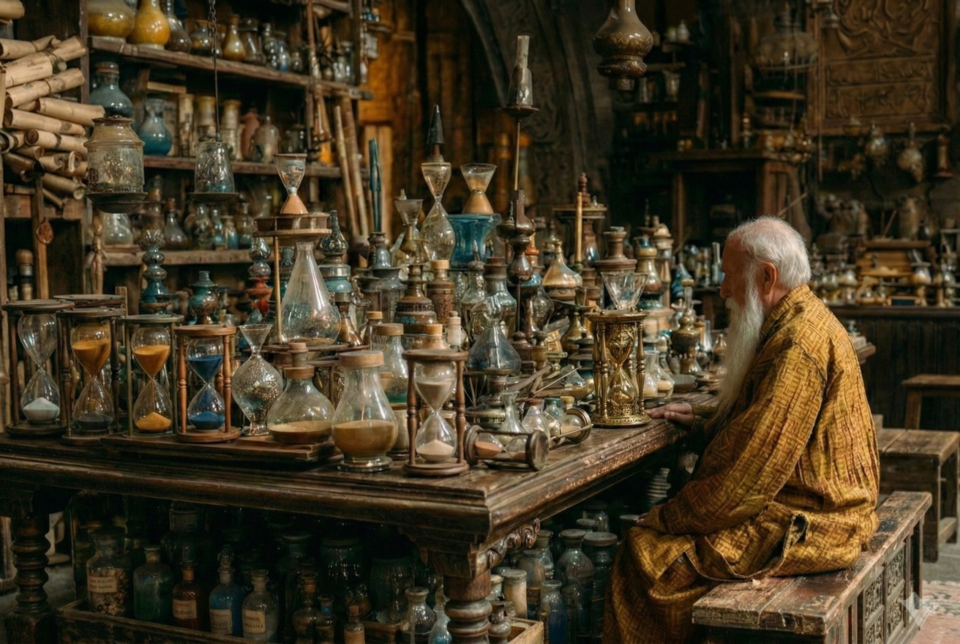
No, that’s not true. This can’t be happening! That cry tore through the silent dawn of the monastery. I woke up startled, still unsure whether that despair came from a bad dream or from the voice of some monk in a nearby room. I calmed myself to listen more carefully. After a few moments, despite the stone walls, it was possible to hear sobbing that resembled deep weeping. I went out into the corridor in an attempt to discover who needed comfort. Without having to walk far, I realized the lamentations were coming from the room next door. The one who occupied it was Hermes, a Greek monk, a resident of Athens, nearly seventy years old. A sensible, kind, and pleasant man, greatly admired by everyone in the monastery, a member of the Order for more than three decades. Trained in Economics, he was a professor at the country’s main public university. Hermes embodied the ancestral values of ethics, aesthetics, and mysticism advocated by Plato, a compatriot from millennia past. He relied on a precious personal code of conduct, crafted throughout his life, always questioning whether his actions and choices favoured what was good and just. He gave in exact proportion to each person’s merit, regardless of the feelings he held for them. Although he practiced physical activities and maintained a healthy Mediterranean diet, taking care of both body and appearance, never out of vanity, but as an exercise in self-esteem, his ultimate concern lay with the aesthetics of the soul, the highest ideal of beauty. Mysticism, in the original sense of the word, encouraged him to seek truth beyond the furthest limits reached by science. Always balanced and attentive, he was often sought out by younger monks in search of guidance and advice.
We knew of the recent passing of his wife. Unlike other study periods, this time he had arrived deeply shaken. Despite his usual delicacy and politeness, Hermes had become somewhat withdrawn. In his free time, he isolated himself on the veranda or took long walks in the mountains. Everyone understood the change in behaviour given the impact of the event. It was a specific situation. The constant reflections were necessary to rearrange life within himself, from now on, without having by his side someone with whom he had celebrated the good moments and shared the anxieties on the reverse side of the best desires. By definition, mourning is the pain arising from a loss. Any loss. There are different kinds of losses. Some are more significant and harder to deal with. The greater the attachment to what was lost, the more entangled the individual becomes in the webs of suffering. When the loss represents the only pillar of support, the person collapses.
Healing from grief requires a restructuring of one’s perspective and, often, a reconstruction of one’s way of being and living. Depending on the loss, it is not uncommon for a complete reinvention of oneself to be necessary. As we are not always ready and open to the indispensable transformations, without realizing it, we allow suffering to take root. Some roots remain for so long that the person begins to consider suffering as an inherent part of their personality. It is not. The intensity and duration of pain vary according to the level of awareness, depending on the capacity to process the experience accurately, extracting immeasurable doses of love and wisdom from it. Then, suffering dissolves forever. Until that happens, pain will spread through the depths and leave a bitter taste in the heart. According to this reasoning, and knowing the enormous capacity for resolution and overcoming of the Greek monk, we believed he would soon be well.
That is why the strangeness of the weeping and the cry coming from his room. When he opened the door, I was startled. Before me, I found a shattered man. Chaos strips away everything that is not attached to essence. It takes away what is ornament and appearance. Those who do not build the foundations that will keep them firm and secure within themselves will be left destroyed after every storm. I did not recognize him. I simply embraced him for long minutes. It was not a time for words. That white-haired man cried like a lost child.
After letting the emotions that suffocated him overflow, I invited him to go with me to the monastery’s canteen. Hermes needed to speak, and I was willing to listen. He agreed. I prepared a pot of fresh coffee and placed it on the table. When I went to get the mugs, I heard a voice behind me: “Three, please.” It was the Elder, as we affectionately called the oldest monk of the Order. He sat at the table with us, looked at Hermes, curved his lips into a simple, yet sincere and beautiful smile, to say, without the need for words, that he was willing to use his own heart in an attempt to rescue him from the turbulent seas of suffering. Those who have already drowned in the waters of misunderstanding or found themselves caught in the currents of grief know the value and importance of such rescues. They are immeasurable.
As he exposed the depths of his pain, I was surprised. Helena’s departure, his wife, to the Highlands was not the primary reason for his despair as I had imagined. Although he loved her deeply and missed her every day, he had learned not to treat death as a loss, but as a boarding platform, the point of departure for a new stretch of learning and achievements, making use of new and unthinkable tools and circumstances, in favour of one’s own evolution. Helena deserved to continue and advance. Death would offer her renewal and regeneration under conditions more suited to the levels of awareness she had achieved. Death would never mean an end or a loss. It was a necessary and important transformation. Never a punishment, but an act of love from life toward life. Like the fruit that, whether consumed or decayed, is reborn revitalized through its own seed.
Undoubtedly, the longing he felt for Helena was immense. Contrary to common understanding, longing was not a reason for sadness. It was a source of joy. After all, we only feel longing for good moments. Not longing as nostalgia, from the absurd desire to go back in time, but from recognizing that longing exists only where there is love. The absence of longing may indicate the emptiness of an existence. On the other hand, its presence narrates the best chapters of our lives. Love once lived brings joy, hope, and dynamism to the movements we still have to make. It also reminds love itself that there will always be many reasons to keep loving more and better.
The Elder smiled again. This time in approval of Hermes’ full understanding of this complicated, yet delicate and beautiful phenomenon, inevitable and natural, called death, still so poorly understood. The problem, commented the Greek monk, was that in the wake of Helena’s departure, other difficult events had arrived. In recent months, some friends had also departed for the Highlands, while others were struck by illnesses that took away their motor autonomy or their ability to express their will. This saddened him greatly. There were also friends who had moved far away, in order to live closer to their children and grandchildren. Helena and he had a son, Andreas, who had also graduated in Economics, but lived in America, where he worked in the financial market. For Hermes, New York was a wonderful city to visit, too frantic to live in. Although his physical mobility and mental cognition remained intact, his health showed signs of decline. Not only the loss of muscle strength and reflexes, common with age. In his case, arthritis and arthrosis, genetic inheritances, forced him into frequent physiotherapy sessions, in addition to permanent medication. It was as if a warning had been lit about the expiration date of his body.
As if that were not enough, a few hours earlier, unable to sleep, he decided to check his email inbox. The Greek Congress had enacted a law establishing compulsory retirement for professors from the age of sixty-five. As he had already passed that age, the university informed him of his removal from the position and duties he had carried out for decades and which still brought him joy and pleasure. He loved teaching and being around young people, full of ideals, dreams, and an immense will to live. He felt good in the freshness of the academic environment, from which, suddenly, he had been cast out. With retirement, he would suffer a drastic cut in his income. Helena’s treatment had drained the savings accumulated over the years, he did not complain about this. She had deserved the best doctors and care. The fact was that, that night, with the reduction in earnings, the losses seemed to have reached their peak, at a level he had not imagined even in the worst scenarios. Among other losses, he had just lost not only social and professional status, but also access to goods of consumption and comfort. None of this had been part of his plans. As if life had turned into an enemy, and, wielding a razor-sharp blade of dreams, precise and insatiable, it took everything away, not only what he possessed, but also the man he had been. At that moment, an internal rupture seemed to occur, between who he had been and who he would become. This unexpected fragmentation caused an unspeakable suffering. He would have to settle for less in all aspects of life. He would need to reinvent himself, to find new reasons to live. He doubted whether he could. The losses seemed irreparable.
At this moment of unimaginable changes, he lived a profound inner contradiction. Even though he carried knowledge about the arcana of life, he missed Helena, running counter to the truths he knew. A strong and loving woman. By her side, he had never felt fear or insecurity. Together, they proved greater than the greatest of problems. They shaped the future according to the achievements of the present. That faith had also been lost, for even though he tried to avoid thinking of events as losses, he perceived life collapsing. Facts appeared more convincing than ideas. He considered the possibility that the belief that losses were illusory might be wrong. Perhaps they were real. That night, he had the horrible sensation that, given the overwhelming pace of recent days, increasingly corrosive and harsh, soon he would lose what he had, the references he possessed, who he had been, and everything else that pleased him. Only the ruins of himself would remain. He did not know how to deal with this, he confessed.
The Elder listened without any interruption. He took a long sip of coffee, as if searching for the exact words, and argued: “Every loss can be real or illusory, depending on how the individual deals with events. When one refuses to accept the inevitable movements of life, one becomes bound to the futile attempt to retain something that can no longer be possessed or to remain beside someone who has already gone. Then, the loss reveals itself as real and painful. Not because of life’s fault, but as a result of the inability to find the wealth hidden behind each departure. By understanding that life takes from us what no longer belongs, we waste the fertile ground of creativity and the unpredictable. Do the best for yourself, offer the best of yourself, and let life surprise you. Whether people and moments, or learning and growth. Life is abundant and generous, although we do not always perceive it that way, especially during chaos. The immature judge chaos by the degree of destruction, the wise take advantage of it for the opportunities of renewal. The foolish treat chaos as a curse, the mature walk through it as a road of regeneration. To regenerate is to rebuild oneself from one’s own core. No one can do that without knowing themselves more and better. There is no greater wealth. For them, chaos is sacred.” Before the Greek monk could intervene, the Elder anticipated his thought: “There is no age for this.”
Since he had joined the Order, Hermes claimed to have learned to face the setbacks of existence, for he knew well that, beyond being inevitable, they are renewing and constructive movements. He had prepared himself for all those situations. If the younger monks sought him out to talk, he would be capable of giving a lesson on the subject. However, he showed enormous difficulty in applying theory to practice. Perhaps because of the many involuntary changes in a short span of time. The joint processing of all those experiences made the best resolution more difficult, he considered. The Elder nodded and clarified: “Life has a logic and a way of operating that is almost never easy to understand. As no one is the same as anyone else, the application of the pedagogical method also differs from one person to another. Therefore, comparisons are inappropriate.”
He set his mug on the table and remarked: “Although the rapid succession of unpleasant events has momentarily affected your balance and your lucidity in facing the torrent of changes, jamming the gears of your driving force, there is nothing that prevents you, at any moment, from regaining power over yourself to move forward. Even if you understand that losses are illusory, they become real when the exact grief that surrounds them is not understood. Then, little by little, the pain spreads and establishes an empire. The individual becomes lost within himself. Every feeling has a name. Until you identify the true reason for the grief, you will not be able to reclaim yourself. You will remain dominated by a suffering that, as long as its origin remains hidden, will make healing impossible. There is no remedy for an unknown pain.”
Hermes asked what he meant. The Elder explained: “You are living the grief of old age.” The Greek looked at him, startled by the use of the word old age, as if it were forbidden or in poor taste, especially coming from someone always so gentle and kind. The good monk warned him: “Do not be afraid of words. Using beautiful words does not diminish the problem. On the contrary, it often masks it, creating a mistaken sense of lessening or disguising its severity. No one changes reality with fine speeches, only with good and correct actions. Everything else is deception and makeup. Using the exact word to describe the exact situation is of great value for understanding and facing the truth.”
The Greek monk nodded. The Elder continued: “Humanity, still lost in its immature longings, is not prepared to deal with the road of time. It is a kind of ignorance by denial. By avoiding the truth, crowds throw themselves into the abyss of isolation, abandonment, or despair as the journey approaches its final stretch. We look at aging as one who hears the whistle of the approaching train of death. A grave mistake. It is necessary to deal with old age as the opportunity to leave behind the tools that were once necessary, but from now on, we must learn to move forward without them. This speaks of autonomy and teaches much about freedom, dignity, and peace. It applies to everything we like and to everyone we love. We lose things, but we keep the good experiences they provided us. People disperse along the path, after all, each has their own direction and needs for learning and evolution, but they leave with us the love and the stories that give meaning, colour, and sweetness to life.”
Then, he asked a simple rhetorical question: “Have you ever noticed that we were never trained and educated, when young, to project life during old age?” Without waiting for the obvious answer, he continued: “Even those who attempt the exercise do it with unrealistic idealizations, softened by sweet scenes of mere fiction. No one wants to look at the inevitable limitations, restrictions, and changes imposed by aging. It will be different with me, they lie to themselves. Because we are unprepared for the final phase of the cycle, we end up facing old age as if it were an accumulation of losses, wasting the fantastic opportunities that the twilight of existence offers. One grieves, maintaining painful losses, in a place within us where wonderful findings could exist.”
The Greek monk’s eyes asked what those findings might be. The Elder listed them: “Life is wise. The growing limitations of the physical body open space for the blossoming of the soul. It is the final call to reposition the pieces on the board of priorities. We hand over the heavy pieces to value the use of those that offer lightness. If there is attention and detachment, the game will become favourable. What truly has value fits in no box, needs no signature, and serves as no currency.” He curved his lips into a beautiful smile and listed: “Forgive everyone, trust yourself, and move forward. To be free, love without holding on. To live in peace, guide without trying to convince. To be happy, act without possessing. To be dignified, truth is enough. For love to germinate, virtues applied to everyday life suffice. All these achievements depend only on perception and sensitivity. Nothing more. There is no greater wealth. I know we know this, but we do not always remember it. So, in the splendour of its wisdom, life offers us the old age of the body as a sacred elixir for the rejuvenation of the soul. Sacred is everything that makes us better people. The art of aging speaks of being more with less.”
He looked out the window for a few moments. The sky was beginning to take on the pink and yellow tones typical of morning. He emptied his mug and added: “Old age takes many things from us. Some of great importance. However, it offers us others even more valuable. It is not an exchange, but unmissable chances for transformation. Exchange has a price, transformation has value. The evening of existence can provide treasures such as emotional balance, material detachment, better acceptance of others’ wills and truths, a clearer perception of reality and a deeper understanding of life, greater lucidity and conscious freedom. There is no time more suitable for plenitude.” He set the mug on the table and concluded: “These are perfect days to review concepts, customs, ideas, feelings, attitudes, and habits. A final opportunity for reconstruction, this time using only one’s own essence as raw material. More than a finding, the final stretch of the journey can provide the most important achievements of a lifetime.”
No one else said a word. Hermes needed to reposition himself before himself and before life. He could cower, hide, and lament. He could also be thankful, rise again, and dance with life. There are always choices. The Greek monk’s open smile of gratitude ended the conversation. His teary eyes said the lesson had been learned. A silent decision had been made.
A few days passed. I noticed in Hermes a youthful restlessness. I do not mean immaturity, but the vitality and freshness typical of youth, whose best meaning reveals itself in the irrepressible will to grow and achieve. When he was not attending classes, he remained focused on notes and exchanging messages. I found it strange and commented to the Elder. The good monk reassured me: “There is no reason for concern. Hermes decided to make use of all his years of study in Economics and the enormous amount of available time, thanks to everything he once considered a loss, to begin an old project. Together with a businessman friend, who passed the direction of the company to his children, they will start a business school, with the aim of training new entrepreneurs. Studying Economics and Administration is only part of what is needed to face the many difficulties common to the complicated and competitive world of business. This lack of knowledge causes many small companies to fail to withstand the initial obstacles, generating frustration by aborting ventures that could have been prosperous and far-reaching. He is very excited to reverse this scenario.”
I asked the Elder whether, in his opinion, the school project would succeed. He reminded me: “To remain young is to continue having dreams, goals, and purposes, regardless of one’s age. It is not giving up nor settling. It is continuing to refine one’s actions, keeping them good, just, and healthy. Do not be alarmed if there are days of relapse and discouragement. Results will sometimes not be as expected, and at other times will take longer than planned. That is how it is. This does not translate into defeat, but invites exercises in versatility, lucidity, discipline, and faith. Victory resides in the light of the best actions, not always in the shine of the desired results.”
He gifted me with a beautiful smile and concluded the conversation: “In recent days, Hermes has grown younger and brought an end to his losses. He understood and accepted the challenge of evolution. The process of improvement must continue, now with different tools and under new conditions. He is about to live some of the most enchanting experiences of his life. No matter what happens, there will be many findings. True success consists of victories over oneself. He is on the right path. He only needs to continue.” Then he said he needed to prune the rose bushes in the monastery’s inner garden. I watched him walk away with his slow, yet steady step.
Translated by: Cazmilian Zórdic
