
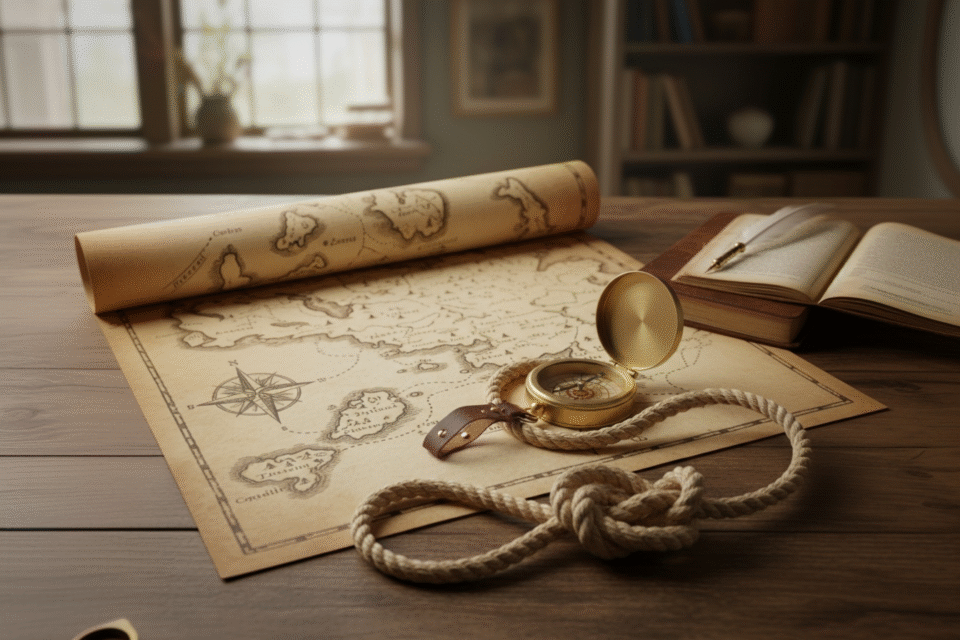
The bus dropped me off in front of the inn in the small Chinese village on the ascent to the Himalayas. The owner handed me the room key with her usual indifference. I left my backpack and set off toward the residence of Li Tzu, the Taoist master. There were still a couple of hours before nightfall. As usual, the gate to the house was open. I crossed the beautiful bonsai garden, under the scent of jasmine incense that emanated from inside the residence. I noticed, hanging on the kitchen doorframe so that everyone could see it, a rope with several knots tied in it. I did not remember having seen it before. Midnight, the black cat who also lived in the house looked at me listlessly from atop the refrigerator, turned his head to the side, and went back to sleep. I was welcomed by Li Tzu with an affable smile and a cup of hot tea. Seated at the table, I asked about the meaning of that rope full of knots. The Taoist master explained: “It is a simple illustration to remind everyone that the teachings of the Tao Te Ching will be of little use if the individual cannot see, understand, and undo the existential knots accumulated throughout life that bind and limit them. An important evolutionary exercise. The true battlefield lies in the core of each person. The way we move through the world is merely its reflection”. I asked whether he could help the students. Li Tzu maintained his habitual sincerity: “Very little. I only hand over a map and a compass at the boarding platform. Nothing more than that. This journey does not allow companions. As for guides, it is only possible to orient from a distance”. He shrugged and emphasized: “Because it is a profound inner movement, no one will ever be able to untie another person’s knots. Each person must do this for themselves. It is an intimate, luminous, and solitary act. It requires determination, courage, and self-love. As a gesture of genuine liberation, untying knots is part of the art learned by travellers on the path toward the light”.
I asked how one unties a knot. The Taoist master stood up, removed the rope hanging on the doorframe, and handed it to me. He told me to do it. I went to the centre of one of the knots, eased the tension of the rope, and undid the binding. He questioned me: “Why didn’t you untie it from the ends of the rope?” I replied that it would not be possible. One can only untie a knot from its central point. Li Tzu smiled, satisfied, and commented: “The same happens with existential knots”.
I wanted to know what those knots consisted of. He clarified: “There are many types. The most common are resentments and guilt. We become resentful or feel guilty for various reasons. Throughout life, we deal with abuses, offenses, and betrayals of different nuances and origins. They are bitter products resulting from poorly elaborated and still incomplete experiences. The acidic feeling that emerges whenever the memory surfaces is not the only problem. Although it is the most perceptible, it is not the most damaging. These sufferings, while not healed, shorten the possibilities for movement and narrow reality. The world and life constrict when truths, good feelings, and different choices remain repressed or denied. Everything we believe to be impossible will remain invisible, as if it did not exist, as long as we do not allow ourselves better understanding. Like all other knots, resentments and guilt dominate us, nullify us, and exhaust us. We are prevented from going beyond who we are or where we are, within and outside ourselves”.
At that moment, we were surprised by the arrival of Maria de Guadalupe. I had met her during another period of studies. Mexican, around forty years old, she was of medium height, with brown skin and black, curly hair, the same shade as her eyes. She wore large, beautiful, colourful earrings. With intelligent and pleasant conversation, warmth was her trademark. A woman of initiative and attitude, who showed she knew who she was, what she wanted, and where she was going. I recalled hearing two young women comment that they wished to be like Maria de Guadalupe, a woman who fills every space in the environment she occupies. Despite her striking presence, there was a concealed sadness in her gaze. As if the agitated waves of the beach diverted attention from the secrets hidden in the deep waters of the sea.
Maria had attended the morning classes, when Li Tzu explained the reasons for hanging the knotted rope on the kitchen doorframe. It had impressed her greatly. She said she needed to talk. The Taoist master invited her to sit at the table with us. Then he served her a cup of tea. We asked nothing, nor was it necessary. With tearful eyes, even before tasting the tea, Guadalupe confessed she was tired. Very tired. Then she told us her story. Or part of it.
An only child of very demanding parents, she had a rigorous upbringing, full of severe assignments. She grew up with obligations beyond her age. She became accustomed to solving the family’s problems. She accepted the burden without questioning or complaining. To forget the pain of giving up her own choices, tastes, and interests, she invented the character of the heroine always ready to help people solve their problems. She felt obliged to perform tasks that were not hers. Over time, she and others came to see this as natural. She considered herself a generous, well-adjusted, and decisive woman. She conditioned herself to assume responsibilities that were not hers. Without knowing how to react, she preferred to believe that abuse was virtue and pleasure.
Still very young, she married Moacir, a charming aspiring musician with much enthusiasm and little talent. By behavioural habit, Guadalupe repeated the pattern: the obligations that should have been shared by the couple fell upon her, since her husband refused to look for other work. He insisted on living off music that brought him nothing, save for bohemian nights in disreputable bars. She soon became a mother, increasing her own levels of commitments and demands. Since adolescence, she had worked in a paper factory during the day and studied at night, without neglecting household chores. Over time, after graduating from university, she climbed several rungs within the company. She had a good salary, compatible with the position she had attained.
Mild-mannered, yet indolent, Moacir contributed nothing to household expenses. Although he was not a good husband, he was an attentive father and a friend to their son, already a young adult. The son, despite having become a loving young man, did not like studying and, as if that were not enough, had an appreciation for his father’s uncommitted lifestyle, whom he considered a free man. Despite the affection she had for her husband, she no longer loved him. She felt uncomfortable at home. She found the family relationship model unfair. However, she pushed away the idea of separation. She was a dignified woman. She had assumed commitments and responsibilities. She knew they would face enormous difficulties if she decided to leave. They had always lived in absolute dependence on her work. She would not bring pain to those she cared for. As in a dilemma with no solution, she did not like what bound her, but she also did not know how to undo the knot that tied her. She was where she no longer wanted to be, but it was better to stay. She confessed that she would feel guilty if she ever left, even though staying meant accepting unhappiness as the only and definitive feeling allotted to her. Perhaps it was her karma, she reflected. Nonetheless, she was resigned, she admitted.
Li Tzu listened to her without interruption. Then, with candour in his eyes and a serene voice, he remarked: “Knots need to be untied as soon as possible, at the risk of having joy strangled and existence wasted. We manage to loosen knots when we revisit events in order to rework our understanding, whether of the feeling provoked by a given experience or of the behaviour we insist on maintaining despite painful results. Every knot arises from the belief that there is no different way to deal with certain situations. Over time, the knot tightens. At times, it suffocates. Suffering seems inevitable and endless. We believe that time will take care of everything. A grave mistake. Time heals nothing. It merely throws layers of sand over the pain, as if it were possible to hide it. In collusion with time, we lie to ourselves by saying that we are fine. There is no greater lie. No one is well when life shrinks while there is so much more waiting”. Li Tzu argued: “All suffering is the result of the wrong elements we use to elaborate lived experiences. Some experiences have not yet ended. Some movements need to be reprocessed with elements never used before. When the result changes, the knot comes undone”.
Guadalupe wanted to know how to do this in practice. The Taoist master sipped his tea and explained: “We will trace the path of your speech from back to front. When you recount your pains, you end by saying that you have no choice. You are imprisoned by the condition of caring for your husband and your son, healthy adults, yet indolent. You believe this to be your karma. And that you are resigned to it. You live surrounded by bitter feelings because you elaborate the experience with these elements of conviction”. She nodded as if to say that this was indeed the case. Li Tzu showed the compass for a new orientation: “Karma is not prison, it is learning. We will remain bound to dense and corrosive feelings as long as we do not find a different way to deal with the situation. There are always choices”. Guadalupe explained that she was tired of talking to Moacir and to her son. They proved insensitive to any change. The Taoist master reflected: “Insisting on changing others is the exercise of fools. For there to be change, a new level of understanding is required. The firm will to leave behind who one has always been in order to become someone else. It is equivalent to a rebirth. This also applies to you. Each person is responsible for the way they live, as well as for the difficulties they face. Accepting this commitment is called maturity”.
He paused before continuing: “Resignation is the acceptance of the inevitable. There is much wisdom in understanding the accomplished fact. A given situation may be finished, such as a dismissal, a separation, or a death, for example. However, the suffering that results from it is not a definitive feeling. There will be pain as long as there is no change in perspective. Only then does a transformation begin. Resignation does not serve as escape nor does it mean giving up. The fact may be accomplished, but if there is pain, the experience is still ongoing. In some cases, internal movements are enough for healing. In others, there is a need for displacement through the world. One way or another, no one can remain resigned in the face of the suffering of an experience that has not yet ended”.
Maria said she would feel guilty if she abandoned them. They would face serious hardships. Li Tzu clarified: “One should not renounce charity or solidarity. They are authentic evolutionary powers. However, it is necessary to understand that difficulties are tools of existential development, they shape character and refine personal capacities. Help whenever possible, but be careful never to take upon yourself a responsibility that is not yours”. She asked what the limit was between charity that saves and help that harms. The Taoist master explained: “Progress is the desired boundary. Every act that delays evolution is harmful. It is contrary to the light. Always act in a way that strengthens those involved, even if it goes against their desire and habit. Improper help overloads some in order to weaken others. Everyone loses. Help those who need to stand up, but do not carry anyone on your back. Interfering in the journey of those who need to learn to walk on their own feet is the reverse of love. At times, before the abyss, genuine charity does not consist in offering wings; it lies in letting them build bridges”.
She asked whether the Taoist master was referring to her husband and son, who were healthy adults. Li Tzu pointed out: “I speak of all who abuse the generosity of others by refusing the effort of work or personal transformation. Guilt is a malevolent invention. They are like invisible reins placed on the heart. We are led by hands that are not our own. Our emotions are manipulated. Freedom and happiness are suppressed. A process of domination, disguised and atrocious. The limit of charity lies in each individual’s responsibility to seek and develop their own capacities. To progress morally, emotionally, mentally, professionally, and spiritually. Generosity is sacred for the healing power it offers to the world. However, the abuse of this virtue generates suffering because it fosters the vice of domination and stagnation. Unnecessary dependencies are created. In the end, everyone stumbles”.
Guadalupe fell silent for a few moments, as if diving deep within herself to bring up something long hidden. Then she confessed that she was hurt by all those who had abused her generosity. Li Tzu corrected her reasoning: “Even if you were educated to serve others improperly, you continue to allow mistreatment when you refuse to react in a different way. You keep hurting yourself through negligence, complacency, and lack of courage. You deny yourself change. You deny yourself knowing true love. Believe me, what hurts you most is not how others treat you, but the way you continue to mistreat yourself”.
Maria took a few sips of tea without any hurry. She needed time to place those ideas, like a traveller who for the first time encounters an unfamiliar map, realizing that there are other paths different from the one she has always taken. As she emptied the cup, she asked the Taoist master whether, by saying no when she had always said yes, the knot would come undone. Li Tzu reflected: “Yes and no”. Then he explained: “The answer is yes, because by processing the experience with new elements, you will achieve different results. No is liberating when it replaces the yes that mistreats and displeases us. Depending on the circumstances, there is love both in giving and in denying. However, for there to be no relapses or emotional stumbles, the change in posture must be supported by clarity and firmness of a new perspective”. And he complemented his reasoning: “The answer is no, as long as the slightest trace of resentment remains. It would be like loosening the knot without untying it definitively. Forgiveness must not be lacking, whether toward others or toward yourself. The past must serve as a school, never become a prison. Without this understanding, the journey will remain incomplete”.
Guadalupe lamented that her relationships had harmed her so much. The Taoist master again corrected her reasoning: “Contrary to what many believe, difficult and complicated relationships, although they are not desired for obvious reasons, are the best laboratories for self-discovery and personal improvement that exist. These existential scientists are the ones who most often progress in their transformations and reconstructions. Provided, of course, that they know how to take advantage of the opportunities with love and wisdom, without losing themselves in unfounded beliefs, discouragement, and useless lamentations. Life unfolds in the change of perspective, and it is transformed when we refine our internal movements so that they serve as secure support for our displacements through the world”.
Guadalupe asked how she should, in practice, act with her family. Li Tzu shrugged and maintained his habitual sincerity: “I have no idea whatsoever. You have been offered the compass and the map. The journey is yours. Learning to make your own decisions is an evolutionary exercise of perception, sensitivity, refinement of virtues, and knowledge of truth. Remember that the consequences of your choices will fall upon you. As long as you do not accept the challenge and responsibility for reconstructing yourself, as well as defining the route by which you will cross life, you will continue to be what others want you to be, without ever getting anywhere”.
We ended that period of studies on the Tao Te Ching without further touching on the subject. I met Maria two years later at a congress for Latin editors in Buenos Aires. As a representative of a multinational paper manufacturer, she was responsible for offering editors a type of pollen paper, of high quality, produced in a less aggressive way toward the environment. She invited me for coffee. She said she wanted to tell me a few things. We went to a pleasant café in Recoleta.
After returning to Mexico, Maria spoke with her husband and son. She had decided to separate from Moacir and was willing to encourage her son to develop his own potential. The young man said that, due to the affinity they had, he would continue living with his father. She left the house to them and deposited a good sum into each of their accounts. Enough to sustain themselves for more than a year, provided they kept their expenses regulated and under control. Enough time to find a job. They could also use the money to set up a small business. Both were satisfied. Thus, Guadalupe departed. She went to live in an apartment in another neighbourhood of the city. After a few months had passed, they sought her out. They had neither jobs nor business. The money was gone. They needed more. It was then that Maria understood that this was an angular moment: she would either prove capable of untying the knot of manipulated emotions or continue guided by the reins of guilt.
Grounded in her own conscience, she stated that she would not give another cent. They were fit to work and earn their own livelihood. There was no better help. Outraged at not being attended to as usual, they shouted insults and curses. Despite the accusations of insensitivity and impiety, Guadalupe did not waver. She remained firm, serene, and unyielding. Although a superficial reading might indicate an attitude of abandonment or selfishness, in truth it was an act of growth and redemption. The well-being provided by the good treatment with which she began to treat herself caused the resentment to dissolve. She was enveloped by a peace until then unknown. She had learned more about love by reworking that family experience than in more than four decades of existence. She lived feelings she had previously believed impossible. Her gaze and smile vouched for her words.
I commented that she had conquered the world. Maria denied it. She said she had conquered herself. And that was enough for her to feel worthy and free. She took from her bag the small book of the Tao Te Ching and showed me the opening verse of poem thirty-three:
“Conquering others is destruction,
Conquering oneself is illumination”.
She was right. From the heart of a woman the same woman had been born. Although she was the same, she was another. The existential knots were finally untied. We toasted to transformation with two cups of double espresso.
Translated by: Cazmilian Zórdic
